Scott Pilgrim makes for an interesting switch for Learn From This: not only is it another critically-acclaimed-if-underperforming movie, but it’s also a series of graphic novels from Bryan Lee O’Malley1 about a typical 20-something slacker from Toronto with typical relationship issues.
The ones about how the baggage from one’s past tends to affect your dating future, especially if you have unresolved issues regarding past relationships, the ones about being honest with yourself about who you are and what you want, the ones about how “I’m in love with this girl but her evil exes have banded together to control her love-life so now I have to fight them all to the death,” kind.
Y’know. The usual.
What makes a bit of a challenge is trying to condense 1100 pages of story into a 2-hour movie and then trying to further condense it into a 2000 word article on what my fellow geeky bretheren should take away from it all aside from massive crushes on Ellen Wong, Mary Elizabeth Winstead and Brie Larsen and a sudden appreciation for Beck and Metric.

*Sigh*
So I’m not going to bother.
Instead, I’ll be focusing on the graphic novel series with it’s rich backstory as well as the movie that brought it to life. Because, frankly, there’s a LOT you can learn from Scott Pilgrim and his precious little life.
You Are Who You Date – It’s said that you can learn a lot about a person by who his or her friends are. You can learn even more by who they are involved with romantically. When we first meet Scott Pilgrim, he’s proudly announcing that – at the age of 23 – he’s dating (if you can call it that) a barely-legal high-school student named Knives Chau. He has next to nothing in common with her aside from a compatible level of immaturity, virtually no physical chemistry…
So why’s he dating her? Well, because his last relationship – a serious, adult relationship – ended badly a year ago. Rather than getting over it and moving on, Scott has actually regressed; he’s gone from dating a mature woman his own age to dating a child because it’s “uncomplicated”. Eventually he moves on to Ramona Flowers who is nothing but complicated… but still can only relate to her on a stunted emotional level.
Ramona, on the other hand, has dated nothing but assholes for the majority of her life, dumping each one for the next cocky pretty-boy who wandered into her field of view. Even when she starts dating Scott – himself a proto-asshole – she can’t quite bring herself to be completely relaxed and honest around him; she always has one foot out the door, looking for the next available exit.
Don’t Date The Ideal – Scott has this issue in spades when it comes to Ramona. He spends most of his relationship with her in (admittedly blissful) ignorance of just about everything but the surface and what he projects onto her. He doesn’t even know how old she is or when her birthday is. Despite being presented with repeated evidence that Ramona is a serial cheater, or that she’s at least partially responsible for the mess that Scott is finding himself in, he can’t quite progress past the idea that she’s the girl of his dreams.
Literally.
Getting Dumped Doesn’t Make You Special – Look, nobody’s denying that break-ups suck. But past a certain point, dwelling on the pain of a break up goes beyond the tragedy of a relationship ending and starts being about fetishizing the break-up itself. Scott is one example, with his year-long recovery from Envy Adams and his similar BSOD reaction to being dumped by Ramona, but it’s the League of Evil Exes that take the cake. Despite being incredibly successful in their own right (a wealthy producer/weapons engineer, an internationally famous actor/skate-boarder, bassist for an up-and-coming indie band, world-renowned robot engineers) or otherwise powerful (a half-ninja and an Indian mystic), not a single one of them seems to be able to get past the fact that a girl they liked dumped them.
Gideon, in fact, takes the cake in this department. The man keeps every girl who ever dumped him in cryogenic suspension, in hopes that some day he can force them to love him. In the film, he implants mind-control chips. In the books, he literally crawled into Ramona’s head in order to ensure that she would always be hung up on him.
The core of his entire identity is, ultimately, the Guy Who Got Dumped. He can’t even perform sexually any more. At the base of it all is the fact that he doesn’t even care about the women any more – they’re just trophies for him. He treats them like dolls or possessions, keeping them in storage so that they can never, ever leave him again.
Even if he succeeded in capturing Ramona and placing her back under his thumb, he still would never manage to fill the hole inside himself.
Don’t Date A Girl Named “Knives” - Seriously. The universe is powered by irony.
Nobody Likes The Man-Child – Scott lives in a state of perpetual immaturity2. He can’t hold down a job. He’s a perpetual freeloader, living almost entirely on his friend’s largesse and good will. He has next to no idea how the real world works, even in a universe that seems to run on video-game logic as much as anything else. He’s a child in a man’s body, floating through life without any concern (or even comprehension) of the potential consequences of his actions. Even after levelling up in volume 4, he can’t manage basic tasks like “not forgetting his keys”.

Young Neil sums it up rather accurately.
You Are Not The Center Of The Universe - Scott Pilgrim and Gideon Graves are self-centered to an absurd degree. Scott can barely acknowledge the people around him when they don’t intersect directly with his own drama. Half of the time, he doesn’t know where his friends work or what’s going on in their lives, no matter how glaringly obvious it is. Kim Pine, his supposed best friend, has entire relationships start and end while Scott is wrapped up in his own precious life. His other best friend comes out of the closet to everybody… and Scott missed it entirely because he was too concerned with his troubles with Ramona. He can barely relate to anyone on a personal level or operate in the real world. The entire universe is – to his mind – arranged to his benefit and if it doesn’t directly affect him, he couldn’t care less. This “It’s All About Me” attitude is what poisons his relationships with his friends and lovers.
Gideon is actually worse in many ways. He roams through the series marking his territory like an incontinent dog. He literally puts his mark on everything he owns and treats people like living dolls rather than people. In the movie, he implants Ramona with a chip, while in the comic, he puts fragments of himself into Ramona’s unconscious mind. The only reason why he doesn’t go all the way and actually brands people with his logo seems to be because it would ruin the collector value.
There’s More Than One Side To the Story – We all indulge in a certain amount of mental editing when it comes to our lives; nothing is ever quite as we remember it being. Part of this is just a function of how memory works; the human memory is notoriously unreliable and prone to being overwritten with fantasies and expectations rather than being a perfect recording of actual events. Part of this is because we all like to think that we’re the heros of our own stories and would rather prefer not to remember the parts that make us look bad. Scott is a prime example of this; while yes there is some manipulation of his memory by Gideon, Scott has spent most of his life in denial of what he’s really like.
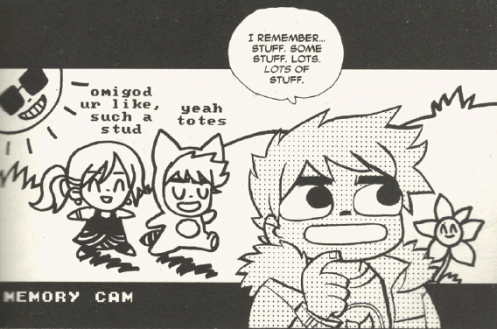
No, that's exactly what it was like. For reals.
After five volumes of seeing Scott as the put-upon hero of this romance we realize that, well… Scott’s kind of an asshole. He beat the shit out of Kim Pine’s weedy, nerdy boyfriend because he wanted to date her. He moved away without even telling his girlfriend, leaving it to her best friend to break the news to her. Envy didn’t dump his ass out of the blue, Scott picked a fight that ended up being the final straw in an already strained relationship.
Own Your Mistakes – While Scott indulges in selective memories, Ramona on the other hand refuses to take responsibility for the fact that all of her relationships have failed. For that matter, she doesn’t take any responsibility for her situation with her Evil Exes.
In fact, she’s actually rather hypocritical about the whole situation. Ramona cheated on just about everybody she ever dated, including two-timing twins… and yet when she has even the slightest suspicion that Scott is having an affair with Lisa, she nearly blows her top. When she finds out that he was dating Knives at the same time he was dating her, she throws Scott out. Never mind the fact that they were presumably not exclusive at the time. Never mind the fact that he was cheating on Knives, not her. Doesn’t matter. She treats Scott as though he were the worst person in the world… without stopping to think that not only is this not anything she hadn’t done herself, but that she’s done far worse.
Which actually leads us to the next topic:
You Can’t Run Away Forever – Scott and Ramona are alike in that neither of them can really face what they’ve done. Scott bundles up all of his guilt and negative memories and crams them away in hopes that he can forget them and be able to live with himself.
Ramona on the other hand, ends every relationship the same way: she runs away as far as she can, as fast as she can. She always has to be the one who leaves – without saying goodbye, if at all possible – because she’s ultimately afraid of being hurt… or facing the consequences of her actions. She’s so afraid of being the one who gets left that she bails at the first sign of complications. She can never be in any relationship without keeping one foot out the door.
Ultimately, neither of them are ever really able to escape from themselves, nor are they ever happy for very long. Both of them work so hard at hiding from themselves and their fears that they take it to absurd levels; Scott has the memory of a goldfish while Ramona disappears whenever she’s at risk of actually letting her guard down.
It’s only when they confront the consequences of their actions – whether it’s Scott facing down Nega-Scott or Ramona finally coming back after running away that they can manage to move on to a real relationship.
The Past Should Be Prologue – Holding on to the past is a recurring theme in Scott Pilgrim. The film and the books are practically dripping in nostalgia, with references to the 8-bit and 16-bit era of video games, 70s and 80s music, comics and pop-culture. The past is also what is holding the characters back from moving on with their lives. While the past should be what lead us to our present, the cast of Scott Pilgrim lives in theirs and seems unable to move on. Scott – and the League of Evil Exes – let themselves be defined by a past that they can’t let go of; Scott goes into a coma whenever Envy’s name is mentioned while the League is so bitter about their break-ups with Ramona that they are trying to control her love-life out of revenge.
Meanwhile Ramona is desperately running from a past that seems to keep catching up with her, literally in some cases, and refusing to give up other parts of her past no matter how much pain it causes her. For a character who fears getting stuck, she spends a great deal of time clinging to anything that keeps her from moving forward.
While yes, she can’t quite give up on Gideon because of his mind-control, it’s representative of that one ex that you just can’t quite get over. These fragments of their past bury themselves deep and begin to fester, infecting our future relationships with other people until we’re willing to stop and take the – often painful – time to excise them.
As tempting as it can be to wallow in the past – especially when the past represents a less complicated, happier time – holding on to the past only retards our ability to live in the present or to make progress towards our future.
No matter how sweet – or painful – the past is, sometimes the best thing you can do is just let go and let the current take you.


I absolutely adore this article, both for the very useful advice and because this is EXACTLY what I thought of Scott Pilgrim. I have a few friends (male nerds for visualization sake) who worship this movie, but for the wrong reasons… they relate too strongly to the proto-douche that is early Scott, and rejoice that he got the hot, perfect (and yes they saw Ramona as perfect) girl in the end. Talk about missing the trees.
Here's my question though… where's the line between learning from the past and letting go of the past? For example, I am very hung up on the fact that I continually date guys who turn out not to be into me, and that I get dumped over and over when the guy "upgrades" to a hotter girl. I know I need to learn something from this… but what? The "you pick jerks" doesn't work, because the guys didn't SEEM like jerks. They seemed like nice, somewhat-stunted, nerdy guys.
If I can't learn from it, how can I avoid repeating it? But I've analyzed it to the point of stagnation without an answer. I feel like I can't move forward without an answer (and repeat the same mistakes), but I can't seem to find the answer either.
When do you look to the past to learn, and when do you let go?
Could be that the the "stuntedness" you noted might be an early sign that they might be nie guys, but not good guys. That "I'mma toss you like an old action figure once the special edition with the new hat comes out" attitude is, to me, a sign that said dude has some personal growth to go through (learning to treat women like people and not prizes) before they should be dated. :/
Marty: I have a similar situation in that I sometimes daydream about telling my last ex-boyfriend that my current boyfriend is better than him in so many ways, and we broke up with me two years ago. My entire life "upgraded" after we broke up, and thanks to several intense therapy sessions, I've curbed or have under control many of the behaviors that caused that last, horrible fight.
So my response is: Therapy. Lots of self-actualization. Re-read some of the Doc's posts about how confidence is sexy. Talk to your good friends about things they may know about you that you can't see in yourself.
I hope this helps.
Simple: Stop thinking that the girl she got it's an "upgraded" version.
See, this is something I'm thinking right now as I'm on the same situation: I had an ex that I was competing so much to get his attention. He ditched me to go to get another boy and from my perspective he's NOT an upgraded version of me: he's clingy, he's a victim all the time, he's self centered, he's needy, jealous and always has to be in control…
…I know he's not better than me, the thing that hurts me is that it's the fact that my ex BELIEVES that he is an upgrade from me.
Now, I could take this in two ways:
a) Actually believe this, that the guy has it better than me.
b) Say no to that idea. It was NEVER because of me.
And let's be honest: I put the world on his feet, I made everything he wanted and perhaps even more. I know it's an error, but it comes from a very special place of me called nobility and loyalty. I know I did many things and commited many mistakes but from the other side, he was also denying me, minimizing me, cheating, lying and stealing from me. At the end, if it didn't happen, it wasn't because of me, it was because he has this crazy idea of what love is and he may have unrealistical expectations of it; it could also be that he indeed loved this other guy and now the attraction is faded and is putting himself through and going into that relationship because he doesn't want to end up alone. (which may also be the reason as to why he never really gave himself fully to me and started a full committed relationship with me, because he didn't want to be alone and was using me "in the mean time").
I will never know for sure, but one thing is true, from now on I will keep on believing this: if it didn't happened it wasn't because I was incomplete, broken or deffective. There was never nothing wrong with me and if it was and he never mentioned it, it was on him. This is not denying that I did many bad things, but I believe that my good actions weigh seriously more than the lies or stalking that I did. Not only that, my good actions were more periodical than my bad actions, unlike on his side where the opposite is true. So yeah.
I would suggest start to think about this. Start to look if it's FACTUALLY TRUE that the guy got an upgraded version of yourself. If not, then it's a lie and you were never replaced or "improved" over.
I legitimately couldn't make it through the first volume because all I could think is, "All of these characters are assholes. Why do I care what they do?" I just couldn't relate to any of them, except possibly Knives in the "I guess I remember being young and naive." sort of way.
Somebody told me they got better. I can't help but feel I'm not missing out on much, though.
Well, it does get better. The entire story is about how these characters realize they're jerks, and take the incentive to fix it.
Although I admit, if you couldn't relate to the characters, I can't say you'll miss much. Personally, Scott Pilgrim reminded me of my high school period (I never dated, though). Like Scott, it dawned at me at one point: "what have I been doing this whole time!?" That was a life-changer, and I'll never look back again.
Personally, I believe the movie is superior because it features all of the problems of Scott and Ramona which are the key concerns/drama of the books, but it leaves out a lot of the slice-of-life adventures of Scott's friends which actually take up a huge chunk of the books. It's all about Scott/Knives/Ramona and it covers the concerns in a much tighter sense.
But I've heard how you gauge Scott Pilgrim really varies from person to person, from where you live to how many people are in your life.
"if it doesn’t directly affect him, he couldn’t care less."
Thank you for not saying 'he could care less'. Far too many people make that mistake.
You know its probably a good idea to expand these "Learn from this:" articles to non movie media. Fans would squee for a Learn from this: Buffy the Vampire Slayer.
This was fantastic, insightful, and overall just a great read. I'm going to share it with my friends!
However, one point stuck out to me and I'll have to disagree with you about it:
"… part of the reason he and Envy eventually break up is because she grows out of her childish interests and fosters new ones …"
Envy sells her beloved collectible anime figurines and manga books for cash to buy expensive clothes and shoes with. As a geeky girl, this scene was rather horrifying to me. She stops being Natalie, the geeky girl who loves anime and manga, and starts being Envy, the hard rocker with the trendy wardrobe. She decides that dressing up and looking good are more important to her than being a fan of anime and manga. This is a thing that a lot of girls go through, usually at a much younger age, where they forsake a hobby or sport or interest because they think they need to be "girly" and give up what they used to love doing so they'll fit in. I don't see Envy's actions as those of an adult growing up, I see them as a woman conforming to what society expects of her: that she be pretty and fashionable and NOT geeky.
At least, that's how I read the scene. As a girl who resisted constantly worrying about my outfits and decided to read books instead of do my hair at recess, maybe I'm projecting my own experiences into this, but I wanted to share my perspective on Envy's actions.
Here's the thing though: not everybody stays geeky for life. Some people really do grow out of it.
And while that can sound negative, implying that being a geek is childish*, changing does mean growing. And Envy clearly felt – even before she became a sell-out – more comfortable with her new identity than she did as Natalie. If we're going to insist that people accept being geeky as an awesome thing, we have to accept that some people will eventually decide to not be geeky and that this is perfectly fine for them too.
* And let's be fair: part of the joy of being a geek is that we allow ourselves to be a little childish. We allow ourselves to enjoy something the way a child does: whole-heartedly without the distancing affect of irony or justifying it by keeping ourselves at a certain distance.
I get that, people do change and Envy's change was her choice and her right … but I didn't like your wording because to me, it read like "being geeky is childish behavior that people need to grow out of, Envy did and became an adult because now she likes designer clothes and shoes" … which confused me because that's not something I think you'd ever intend to say, having read lots of your articles.
Girls have to put up with this annoying attitude all the time growing up, i.e. "you say that now, but soon you'll start liking boys and going shopping and putting on makeup, you'll see!" and the implication is that we'll forget all about soccer/anime/books and become "real girls" interested in "girly" things. Which is incredibly frustrating to say the least. When I read the Envy flashback in the Scott Pilgrim book, I thought "that's so sad, she gave up all the stuff she used to love and now she's a girly-girl." I'd been told I was going to become a "girly-girl" someday so much that for a while I hated pink and felt hostile towards girls who were dressing up and taking forever to do their hair. I saw it as weakness and "giving in." I assumed they'd be mean and shallow, because that was how pretty girls were in movies and tv, where femininity is usually equated with weakness.
I've really only started to lose that mindset after having come to college, where girls can be geeks and girly, girls can be geeks and forget to brush their hair and wear the same shirt for three days, and girls can just not be geeks. And that's all fine. But I don't automatically associate getting interested in fashion with adulthood or being geeky with being childish.
Certain kinds of geeking out can be childish. I don't know if I'd say all geeking out is, though. It's just part of being a geek of any age. Would you classify, say, sports fans at a game as "childish" behavior? (Gotta admit, sports fans share a lot of similarities with geeks … though nobody wants to admit that. Painting your whole body to attend an event with your friends: preparation for comic con or a football game?)
Bu Envy doesn't give up her geeky hobbies to become some kind of Stepford preppie. Envy gives them up to become an indie rock goddess en route to superstardom. That is hardly the same as "going mainstream"; that is devoting yourself to a career that requires a lot of hard work, time and dedication, where image and presentation are important, and which might ultimately end in spectacular failure. No, I found Envy's choices to be gutsy and brave–here was a woman who decided what she wanted and what she needed to do to achieve it, and once she freed herself from Scott and Gideon's manipulations, could pursue those goals independently.
"What's the point of being grown up if we can't act a little chidish at times" -The Forth Doctor.
These things happen, I grew out of being a "metalhead/Mosher", I don't think its childish but it just wasn't me anymore, that is kind of what happens to Envy and her geek identity
I disagree with this a lot. I think those actions weren't really her conforming to society but probably more of as interests changing.
What bothers me more is that you seem to think that being a geek and being fashionable can't mix. It completely can. I think I'm a good example of that. Sure, I do occasionally sell some of my geeky stuff and use that money to buy fashion goods, but I sell them because I don't really have any interest in them anymore. I actually recently sold some old manga of mine, but mostly to make room for some other books I bought lol.
I keep up with the trends for the season, as well as the latest releases for video games, anime and manga.
You CAN be both, it doesn't always have to be one or the other.
I really do love this article, and I'm so happy that this series was picked out for analysis. Everything you point out is a really important factor to what gives the series depth. And while I believe the story somewhat falls apart in the last book, the evolution of Scott and Ramona's relationship and how they grow as people is what I really loved. It's a very good study on character depth.
The book has a few blunt messages. Particularly with "Geeks can be assholes" and "You have to grow as a person." That's why I think this subject is perfect for Dr. Nerdlove because there's a myriad of problems that each character has that can really be understood. People can learn a lot about how you treat others from this series, if you understand how Scott and Ramona are very flawed. I think one of the best parts is when Knives and Scott kiss each other in the 6th part, and then immediately acknowledge "That was horrible." There's a lot of substance here and I'm glad you covered over every part as your did.
However, I will bring up one subject that might be worth looking into. You mention "It’s said that you can learn a lot about a person by who his or her friends are." One thing I didn't like about the ending, was practically how all of Scott's friends are still the incredibly negative people they are. We see everything from Scott's POV, but I couldn't give any of them the benefit of the doubt because of how just plain awful they are from start to finish. And I think they all kind of play a part in why Scott is the way he is. Scott is an asshole, but he was also very positive and rarely intentionally an asshole. Other than Wallace, many of the people at Scott's age have a primary trait of being a total dick in their own right. (Stephen, Julie, Kim, Neil, and Stacey) Even if they are more mature than Scott, it's odd how they continue to be around him but always seem naturally bitter.
But anyway, fantastic job with the article Nerdlove. I always learn something from this blog every day.
Maybe it's just me, but with an exception of Julie and Stacy (due to lack of highlight), I thought the comic made all the characters get over their past. Kim was noticeably less sarcastic as the series goes on, and both Neil and Knives get over their break-up. Stephen, of course, takes his own course in life, never to bother the team again with his perfectionism. And Wallace, well, he's his own man from the beginning.
Plus, I'd argue due to the unreliable narrator that all the characters were probably not as much as a dick as the comics depicted (excluding Scott and Ramona, who were obviously glorified). Granted, that means that we'll never know whether some of the characters were really that bad or not, but to me, most of it looked like an unrealistic exaggeration. Rightfully so, of course, because the world seen by Scott, pre-ending, was equally unrealistic.
“It’s said that you can learn a lot about a person by who his or her friends are.”
one thing I notice about people who are dicks are usually because their parents were too. the saying is true though because jerks are attracted to jerks. t's a neverending cycle. and the lone person in the group of friends who isn't an asshole is usually too afraid to ever say or do anything about it.
I haven't read the comics but I'm excited to do so when I have the chance. From the movie, though, my favorite part is where they learn from their mistakes (Scott, Ramona, and Knives). The humor and video game references along the way are the icing on the cake.
Yes, the characters are flawed in many ways, but to me that's what makes them human. I'm not fond of 'everyman' action heroes that their only flaw is they don't have the physical capabilities of superman and bullets can actually kill them (if they ever get hit by one). I like a jerk as a protagonist, and I like it even better when they grow out of it. As long as they have redeeming qualities even from the beginning, though, so I actually care what happens to them.
I also like in the movie that the power of self-esteem was even stronger than the power of love. I thought that sent a great message. And then when 'Nega Scott' comes out and you expect a fight and he actually gets along with him, I thought that was another good message (although it has the potential to be interpreted badly.) I interpreted it as "everyone has a dark side, do you fight with it, or do you get along with it and not let it control you or beat you up?"
My point is, I agree with everything you said about the flaws and mistakes of the characters and why they're all basically children when it comes to maturity levels in relationships. But to me, they're children struggling to be adults. And that's a struggle everyone makes (or should make) at some time in their lives. How late in life, and how long and hard of a struggle it is, will vary, but it's a struggle everyone can identify with. And that's why I like the movie and want to read the comics.
You list all the things that are bad about the movie but very little that's actually good. =(
Thank you for this article. I haven't read the comics, just seen the movie, so my judgment is based on that – but in sum, I was deeply disturbed by the ending. Scott isn't a proto-asshole, he *is* a raging asshole. Gideon Graves was an asshole of the cartoon-villain variety, whereas Scott was an asshole of the "I know that guy. He's everywhere. I've been screwed over by that guy." variety. And yet he gets his happy ending with all his friends intact and enemies vanquished, and there was not enough acknowledgment that he's really felt the consequences of his assholery. I feel the movie's glibness and light touch did a disservice towards that at the end.
If it were just the movie, I wouldn't be so disturbed. But so many of my (male) nerd friends go all starry-eyed over t his movie the way women are supposed to go starry-eyed over romantic comedies. In fact, I think this is basically the nerd equivalent of a romantic comedy. And I hate that they're taking away this message, that you can act like that and still get the pale perfect nerd girl. It screws over themselves and any future partners they come across.
Sorry to necro this but I just stumbled upon it and I can't get one thing out of my head. Regarding Ramona's reaction to Scott cheating you wrote"Never mind the fact that they were presumably not exclusive at the time. Never mind the fact that he was cheating on Knives, not her." the first part I'm get, but the second part here threw me off. If Scott would have told Knives and Ramona that he was exclusive with them he would be cheating on the both of them. It seems to me that you're saying that he's only cheating on the one who was there first and that the newcomer shuld just forgive him if it's revealed. But isn't it just as bad telling a woman that you're exclusive regardless of whether you got into another relationship before or after you started one with her? It might just be a misunderstanding on my part, but I would really appreciate if you would clarify what you meant here.