
On Labeling Women “Crazy”

« Previous 1 2 View All Next »

I’ve had to quit telling stories about crazy exes or women I’ve dated.

The problem was that I started realizing that when my friends and I would talk about our crazy exes or what-have-you, more often than not, we weren’t talking about ex girlfriends or random dates who exhibited signs of  genuine mental health issues. Now I did have a few where I would qualify my story with “No, I don’t mean ‘we broke up and I can’t be bothered to figure out where things went wrong, I mean that she was diagnosed with borderline personality disorder and was starting to show signs of genuine paranoia,” but for the most part, crazy meant “acting in a way I didn’t like.”

And I didn’t realize just how damaging this attitude was in the way I related to women.

Part of my journey towards getting better with women was having to unlearn a lot of old attitudes and habits when it came towards dealing with the opposite sex.  I, like most men, grew up in an world where certain attitudes towards women were just “the way things were” and we absorbed them without thinking about them.

One of them was the tendency to use labels like “crazy” or “irrational” without thinking. And once I noticed my tendency towards tossing “crazy” out as a verbal short cut, I couldn’t not see it everywhere.

It’s a habit that we men need to break; it’s damaging to relationships, trivializes genuine mental health issues and – most importantly – hurts women as a whole.

The Five Deadly Words

There are certain words that are applied to women specifically in order to manipulate them into compliance: “Slut”, “Bitch”, “Ugly/Fat” and of course, “Crazy”. These words encapsulate what society defines as the worst possible things a woman can be. Slut-shaming is used to coerce women into restricting their own sexuality into a pre-approved vision of feminine modesty and restraint. “Bitch” is used against women who might be seen as being too aggressive or assertive… acting, in other words, like a man might. “Ugly” or “Fat” are used – frequently interchangeably - to remind them that their core worth is based on a specific definition of beauty, and to deviate from it is to devalue not only oneself but to render her accomplishments or concerns as invalid.

“Crazy” may well be the most insidious one of the four because it encompasses so much. At its base, calling women “crazy” is a way of waving away any behavior that men might find undesirable while simultaneously absolving those same men from responsibility. Why did you break up with her? Well, she was crazy. Said something a woman might find offensive? Stop being so sensitive.

“It’s perfectly reasonable for these women to text me naked photos of themselves. You’re just being irrational, honey!”

The idea of the “crazy” woman is so vague and nebulous that it can apply to just about any scenario.

“Crazy” Women

The association between women’s behavior and being labeled “crazy” has a long and infamous history in Western culture. The word “hysteria” – defined as “behavior exhibiting excessive or uncontrollable emotion, such as fear or panic,” is derived from the ancient Greek word “hystera” – meaning uterus. Until the early 20th century, female hysteria was the official medical diagnosis for a truly massive array of symptoms in women including but not limited to: loss of appetite, nervousness, irritability, fluid retention, emotional excitability,  outbursts of negativity, excessive sexual desire and “a tendency to cause trouble”.

(Worth noting: much of the blame for “female hysteria” was placed on “wandering uterus syndrome” or other sexual “dysfunctions”. While this did eventually lead to the invention of the vibrator, one of the common cures was a clitorectomy. )
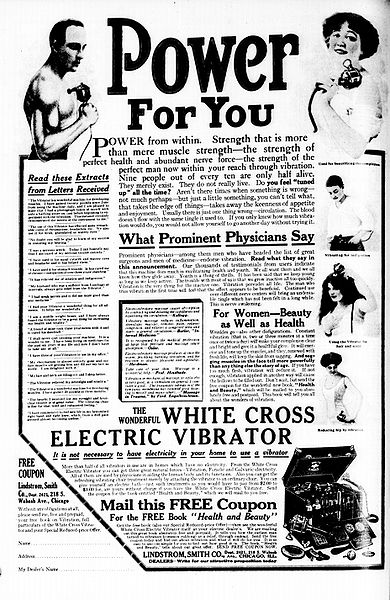
“Now available without a doctor’s prescription!”

While some of the symptoms of  ”female hysteria” could be signs of legitimate (if mis-diagnosed) mental health issues, most of it described male (as the medical field was a men-only profession up until the mid-19th century) discomfort with women’s behavior and sexuality. Calling it a medical issue meant that men didn’t have to respond to behavior that challenged male sensibilities or belief structures. Instead, labeling women as “hysterical” made it much easier to diminish women’s concerns and issues without having to pause to consider them as possibly being valid.

What Guys Mean When We Say “You’re Overreacting”…

Men on the whole are quick to toss the “crazy” label onto women without stopping to think about it what they’re saying. It’s almost a reflexive response to a host of behaviors that men find inconvenient or undesirable.

Stop me if any of this sounds like something you’ve said – or heard – in a relationship. “You’re overreacting.” “Don’t worry about it so much, you’re over-thinking it.” “Stop being so defensive.”

It does to me.

I’ve said all of these things to women I’d been dating. I’m willing to bet most of the men have said something similar and the women have heard it more times than they can count.

To give a personal example:

Back in the bad old days, I was notoriously self-absorbed. It wasn’t that I thought that I was the greatest thing ever, it was just that I didn’t really stop to spare too many thoughts for others. I was willing to make an effort for others, but only so far as it didn’t really inconvenience me past a “reasonable” point. I didn’t want to have long drawn out conversations about how my behavior made my girlfriend feel and I certainly didn’t want to get dragged into what I saw as unnecessary drama. In fact, I was incredibly drama-averse, thanks to an early unhealthy relationship.

As a result… well, I wasn’t willing to consider how others were feeling. When the woman I was dating would try to explain to me how the way I treated her felt,  I would tell her that she was seeing things. She was overreacting to inconsequential stuff. She was being over-sensitive, reading things into what I was saying or doing that just weren’t there.

The subtext to everything I was saying was simple: “You are behaving in a way that I find inconvenient, and I want to you to stop.” I wasn’t willing to engage with her emotionally and address her very real concerns because I was too wrapped up in my own shit to think about other people. As a result, I would minimize her issues. By telling her that she was reading too much into things, I was framing the situation as her being irrational.

I didn’t realize it at the time, but what I was doing was, in effect, telling her that she didn’t have the right to feel the way she felt… because I didn’t want her to feel that way.

Needless to say, that relationship didn’t last long. Neither did the ones that followed. It wasn’t until I was willing to change my attitudes towards dating and how I related to women that I started having more meaningful relationships, whether casual or long term.

Gaslighting and Emotional Manipulation

When someone talks about the woman who he broke up with because she called too often or seemed get emotionally involved faster than he was comfortable with, because she got angry with him over the way he acted, she was always arguing with him about stuff or even that she wanted different things from the relationship, it’s not uncommon to hear “That’s why you don’t stick it in the crazy.” The man is absolved of any responsibility for the break up; it’s not because he was willing to pretend to be on the same page as her regarding the future of the relationship because it was convenient and meant that he could continue sleeping with her, it’s because she was crazy. It’s not because he was unwilling to discuss her concerns. She’s crazy, case closed, time to move on to the next woman without pausing to reflect.

By dismissing a woman’s behavior or concerns as crazy, we inadvertently take part in a behavior known as “gaslighting”. Named for the classic George Cukor movie, gaslighting is a term used by psychologists to describe abusive behavior where a person is made to feel as though their emotions and reactions are irrational, even (dare I say) crazy. By constantly minimizing and dismissing someone’s reactions, we make them feel uncomfortable with themselves and cause them to start to doubt their own feelings. If they’re being told over and over again that what they’re feeling is irrational or unreal, that what they’re feeling is somehow out of whack, then they start to accept that maybe it is.

This wasn’t a “How To” guide, people.

Even when it’s not. Especially when it’s not.

Gaslighting – minimizing their feelings, reframing them as being unreasonable – is classic abusive behavior. It’s telling someone that they don’t have a right to the way they feel because what they’re feeling is wrong. Their feelings or their concerns or behavior isn’t “rational”. Once you take away their right to their feelings, it’s that much easier to manipulate a person into the way you want them to behave.

Labeling women as “crazy” is a way of controlling them. It may not be something planned or pre-meditated, but the ease with which men call women “crazy” says a lot about them. Calling a woman “crazy” is quick and easy shut-down to any discussion. Once the “crazy” card has been pulled out, women are now put on the defensive: the onus is no longer on the man to address her concerns or her issue, it’s on her to justify her behavior, to prove that she is not, in fact, crazy or irrational. Men don’t even have to provide any sort of argument back – it’s a classic catch-22; “the fact that you don’t even see that you’re acting crazy is just proof that it’s crazy.”

“What’s Your Damage?”

The trend of labeling women “crazy” is part of the culture that socializes women to go along to get along. When women are told over and over again that they’re not allowed to feel the way they feel and that they’re being “unreasonable” or “oversensitive”, they’re conditioned to not trust their own emotions. Their behavior – being assertive, even demanding or standing up for how they feel –  becomes an “inconvenience” to men and they’re taught not to give offense and to consider the feelings of others before their own.

Casually, even reflexively calling women crazy and the stigmatization of “crazy” (i.e. inconvenient or uncomfortable) behavior has become a way of trying to keep women behaving in a very specific and limited manner. It perpetuates the madonna/whore dichotomy – that women are either submissive, demure and sexually restrained or irrational bitches on wheels, the emotional equivalent of  riding Space Mountain after five shots of Mescal.

We may not intend to manipulate women this way – most of the time we’re not even aware that we’re doing it. Most of us are conditioned into it; it’s a part of the subtle background radiation that still teaches us that women’s desires and opinions are secondary to men’s. But the fact that we don’t mean to cause harm doesn’t change the fact that we do without even thinking about it.

Sure, we taught you that you should never trust your own feelings and that standing up for what you want is bad but there’s no real harm done right?

As with other bad habits and acculturation, we need to unlearn this tendency to use “crazy” as a weapon. It’s only by recognizing this behavior in ourselves and teaching ourselves to avoid it that we can quit poisoning how we relate to one another and letting it hold us back from the relationships we all want.


« Previous 1 2 View All Next »

Pages: 1 2

Comments

  1. I don't toss the word crazy around, but when a girl I date decides to slash my tires. Or send me creepy text messages months after we broke up I believe it's perfectly acceptable to put her in that category.

    • Valerie says:

      The point is though that you are using "crazy" as a catchall word. It has a lot of connotations to it, many of which you might not mean.

      There are other word choices. She was harassing you. She was stalking you. The behavior was absolutely *not okay* but labeling her as "crazy" isn't necessarily okay either.

      • Especially since this usage of that word trivializes the experiences of people who actually suffer from a mental illness.

        • Valerie says:

          Exactly!

          • Michael says:

            I think slashing of tires qualifies as crazy, in any situation, applying both to men and women.

            however, i agree that it is really insensitive to apply this term to anyone who is just reacting like a regular human being in a way you don't like.

    • Right but the Doctor isn't talking about actual fucked up behavior here. He's talking about institutions which make men think it's okay to devalue the emotions of women in their lives.

    • @progshell says:

      I'd suggest that that behaviour would be better categorized as "scary" or "creepy." That way you avoid lumping yourself in with the bros who are all "I fucked her married sister and she flipped out at me! Bro, that bitch was crazy!"

    • Try using more words. like "she damaged my personal property and and sent me weird and alarming texts when we broke up."

    • I'm not accusing of anything but I have to say that men do things to women that blows us off the top. I think men feel at liberty to speak to us however they please or do whatever they and get away with it but the moment we react to their actions, we're crazy?
      I put an ex on blast just recently. He emotionally played with me for months. I'm a VERY patient person by nature and I intend to stay this way but if you keep pushing me to the edge such playing with my feelings, telling me I'm crazy, calling me names because you're peeved off, disrespecting me in my own home, etc., men like that deserve to be put on blast…or their tires slashed.
      I think what I'm trying to saying here is that more men need to start recognizing THEIR irrational behaviors. I think more men need to start showing more respect for women. Most women who react they way your ex reacted is due to something that their ex/guy did. Try this for size: After you broke up, did you contact her? Did you sleep with her? OR did you cut complete contact with her?

      • LMAO. You think its cool to slash someone's tires because they weren't "nice" to you emotionally?

        If you did that to my tires you'd be in jail.

      • Clementine Danger says:

        "men like that deserve to be put on blast…or their tires slashed."

        Men like that deserve to get professional help so they will never do that to someone else again. And if you feel so angry at all men, you owe it to yourself to get to a better place too. I don't know what being "put on blast" means, but I'm going to go ahead and say it's not productive. Getting stuck in a spiral of anger and revenge will damage you more than the people who hurt you. I learned that the hard way.

  2. Ryan Fraer says:

    There's a difference between "Bro, she was so crazy. She freaked the fuck out when I didn't tell her I was going to the bar or when my ex texted me out of nowhere" and "Dude, she was so crazy. She ran over my cat, had her taxidermied and gave her to me for our anniversary."

    • Nobody disputed that. It's hilarious how some people are already on the defensive. Unbalanced behavior is unbalanced behavior. Actual unbalanced behavior is not the subject of this post.

      • Not saying I disagree with you, but you've been both the most defensive and offensive member of this debate thus far.

    • Did you not absorb this article? There's a difference between having actual mental imbalances but here you are excusing male group ex shit talk either way. Besides, I doubt you know of any woman who ran over a cat intentionally. So what excuses the term "cazy"? Not cool.

  3. Rebecca says:

    Boy, do I recognize this one. A man I used to know told me to "calm down" every time I disagreed with him. Being told to "be calm" when all I'd said was I'd rather have soup than a sandwich was infuriating. He was not in the picture long.

    • RikiTiki says:

      That is exactly how a brother of mine acts. Like when my mother will remind him to do something, in a normal stern tone, it's all "calm down!" I'd like to calm him down sometimes and knock some self-awareness into him.

  4. Relevant to your interests:

    A message from all women from a man: "You are not crazy."

    On calling women 'crazy' (Jezebel)

    I'm glad to see this topic starting to be addressed more and more.

    • The Jezebel article seemed to basically be "This one guy was an ass, so there is a systemic problem with all men everywhere."

      The comments bring up an interesting correlation between calling women "crazy," and calling men "creepy." I'm not sure if it's 100% valid, but still, interesting.

      • The difference is that "creepy" is about personal safety and "crazy" is (usually) about inconvenience and annoyance.

        How does the Dr feel about neurotic? It's not (to my knowledge) genderally charged, and I think it actually does accurately describe my past partners who I was erroneously describing as crazy.

        • "The difference is that “creepy” is about personal safety and “crazy” is (usually) about inconvenience and annoyance."

          I would argue that "crazy" is more about emotional safety, while "creepy" is about physical safety. I think they're similar ideas with similar issues, but different levels of severity.

          • No, I think this is false equivalency. You need to think about the context in which these two descriptors are used. Women use "creepy" for a guy they wouldn't date. "Crazy" is used on women guys have, or had, relationships with. There's no emotional investment between women and "creepy" guys. They are not similar at all, except in the fact that they're both adjectives.

          • From one dude to another, you're just not getting the bigger picture here. Think, really think and don't be defensive. You and I both know what's up here.

  5. Thanks for this. The dating world is rough enough at the best of times and made even worse by my diagnosed panic disorder and recurring major depression. I was easy to gaslight and manipulate because I was having my own problems navigating illness and treatment. Knowing exes publically revelled in the cray-cray that was dating me made things so much worse. It took years to accept that my behavior in response to them was remarkably normal.

  6. Patrick says:

    I agree with pretty much everything the Dr. says above. The tricky part, though, is people (myself definitely included) do get irrational sometimes.

  7. I agree with what you're saying. Both men and women alike would benefit from stopping to genuinely think about why their partner is reacting in a certain way before dismissing their feelings.

    However, this begs the question of what course of action to take when encountering someone who truly is over-sensitive or over-thinking something. What do you say when you've objectively looked at yourself, your partner, and the situation and still draw the same conclusion?

    • I think you explain your side of the story without being condescending or dictatorial and then give them space to run their course, and hope they'll come around. Of course, you have to make damn sure that you really did look at the situation objectively and aren't one of those people who have deluded themselves into thinking that they think objectively. It's a really easy trap to fall into – usually I go talk to people outside the situation, especially people who aren't invested in making me feel good, to get a handle on my perspective.

      If you've taken all the steps and explained your case and tried to understand your partner's side the genuine over-sensitivity or over-thinking pattern continues repeatedly, it would be better to walk away.

  8. "we weren’t talking about ex girlfriends or random dates who exhibited signs of genuine mental health issues"

    I really hope you and your friends never did this period though. as someone with mental illness I would find that extremely offensive. we're not here to entertain people.

  9. I've had the "calm down" thrown at me when I called an unaccompanied bloke out for parking in the last parent/child space. Even in day to day situations our feelings, right to be assertive is/are belittled.

  10. CaptainBobo says:

    Wow Doc, very insightful article. This topic is something I haven't really thought about before, nor have I really seen discussed anywhere else. This was a very enjoyable read, thanks again for providing both an informative and entertaining article.

  11. The problem with the word crazy is that it is not very well defined. I disagree that it is a way of controlling women however. In my experience, crazy doesn't mean "doing something that I don't like," crazy means "has deep-seated emotional issues and/or insecurities that I can't/don't want to deal with" (it also occasionally means "is very weird"). It's usually used to describe someone that you should avoid/be careful around/not ever become romantically involved with ("don't stick your dick in crazy"). Are there better, more descriptive ways of saying this? Probably, but I don't think that miscommunication is the issue here.

    Some people have issues, and unless those issues are major or dangerous to others, they are not anyone else's responsibility but their own.

    • Why are you defending guys who use "crazy" to shut women up and devalue their opinions? Also "Don't stick your dick in the crazy" is misogynistic and dehumanizing as fuck.

      • It's crude, yes, but I think "don't stick your dick in crazy" usually translates to "do not become romantically involved with her, she has deep-seated issues that you will not be able to deal with," which sounds like good advice to me. It also goes both ways ("don't let crazy stick it's dick in you" maybe?).

        Also the issue is usually not with the opinions themselves, but with how they are being expressed.

        • Right. I take issue with guys who dehumanize women they don't want to have intercourse with.

          • I'm pretty sure that "don't stick your dick in crazy" implies that the guy in question DOES want to have intercourse with the "crazy" woman, but he should not, because that would be potentially damaging for him and also possibly for her.

            Again, it's crudely put, but not misogynist.

          • I'm with Beth on this one. I've seen people give the "crazy" warning signs about women that they really didn't even know or only briefly dated her to find out she wasn't want he wanted after they slept with her. I'm tired of other men supporting this really unintelligent wolf pack way of thinking. My wife was once described to me as a "crazy" and is one of the most amazing people I've ever met. I'm glad I didn't take the misogynist advice. A lot of the guys (not all) usually see the word feminist as a four letter word.

          • Well clearly sticking your fingers in your ears and chanting "It's not misogynistic" makes it true!

          • Saying "This is misogynistic!" over and over again does not actually make you more right.

          • http://www.flickr.com/photos/44874164@N08/4537262

            Just replace "racist" with "misogynistic".

          • So, what you're saying is, referring to a woman as merely a fuck toy, but an unsuitable fuck toy because she's not dlocile and compliant enough for you, ISN'T misogyny.

            Perhaps learning what the word means, instead of cowering behind a ridiculously assinine logical fallcy would help you be less of an asshole. Maybe.

          • That is extremely ignorant.

        • Referring a woman as a thing you stick your dick in sounds pretty misogynist to me.

        • um, "Referring *to* a woman…"

    • Paul Rivers says:

      Max – exactly. I don't hear "don't stick your dick in crazy" very often, but oddly enough I did hear it two days ago. It was the conclusion of the story where a guy dated a genuinely crazy chick, who came back and tried to *kill* him.

      Sometimes it's a little less extreme, it's more about the psychological damage the person will unwittingly do to you, or the social or property damage they'll eventually inflict.

      The sentiment behind the saying is something that actually applies quite well to *both* genders, I think the male-specific phrasing is more that men need a much stronger reminder to filter who they're interested in sleeping with past "is she attractive and is she into me".

  12. It's not just girlfriends who object to this sort of thing, though girlfriends definitely do object. Crazy, along with fat/ugly and slut and bitch, are some of the reasons I don't see or talk with my father.

    • Kelly F. says:

      I agree. My dad would constantly tell me, "you must be mentally retarded" and "you're too sensitive".

      Whenever I tried to talk about how that made me feel he would just get defensive and act like I was being hysterical.

    • In the same boat here as well. If I heard "dumb ass bitch" or "learn to take a joke" or "you're too damn sensitive" one time, I heard any one of them a thousand times over. Probably more too.

      This is why restraining orders are wonderful things.

  13. Awesome article!

    It's telling that many people who agree with the fundamentals you've outlined feel compelled now to beg for the dialogue to talk about emotional or irrational behavior in their partners.

    Yes, everyone is less than 100% rational in their daily lives and certainly in their relationships. In fact, if you care about your relationships at all, you're going to be emotional and irrational at times. But that's not really the point.

    If my partner unloads on me about something I did that's upset him, I have two choices. I can suppose that my partner is foolish and wrong and not worthy of my attention, which says more about me than it does about him. Or, I can listen, explain and concede where my actions caused a problem and how we can avoid such a problem in the future.

    The first choice is guaranteed to build resentment in your partner and leave them feeling dismissed and devalued. Even if I am technically not wrong for what I did, it left him feeling lousy and deciding that I don't care does nothing to alleviate that feeling. The second choice, to make him feel heard and understood, or to have him tell me why my actions hurt him is the basis for so-called "good communication".

    EVERYONE knows crazy people, men and women. But men seem to get "creepy" while women get "crazy". If someone gets called creepy in front of me, I call upon their accuser to explain what specific behavior the person has engaged in to be tarred with such a brush. The same should go for "crazy". Yes, lots of those people exist, but don't cast the person you're dating in with that dark lot. If your partner has a mental illness, help them seek out a qualified professional. Otherwise, stop using that damn word.

    • The men who tend to get called creepy by me are like the guy who sidled up to me in a pub, put a five pound note in the back pocket of my trousers and told me to buy a drink with it. Or the guys at a nightclub who come and dance up behind you who you don't notice until their crotch bumps into your bum, nice! I normally turn around with the latter and tell them to take a hike. Or the guy at my work (a manager) who really obviously looks at my boobs all the time, I am always covered up but very blessed, however all the other men at my work can control themselves!!

  14. Rachael says:

    I'm glad you brought up gaslighting. I was going to mention it. I read about the term for the first time last year. The article was very interesting and I considered it to be very important, thusly, posted a link on my facebook. My ex husband had some supposedly witty to say about the mental soundness of women in response. Oh yeah. We're divorced now. Anyways, excellent article!

  15. And what about true cases of craziness? Will a neurotic girlfriend label my responses to her truly unstable behavior as "gaslighting"? Did the poor guy on the past story had his abusive girlfriend labeling his defense responses as "emotional manipulation".

    This article claims that men have been absolving themselves from their behavior by calling women "crazy" when in fact it is putting ALL responsibility on men.

    This is not a fair article: "Gaslighting" and "Emotional Manipulation" can also be applied to denigrate and downplay true cases of men standing up for their own.

    On Labeling Men "Creepy" – It men's fault!

    On Labeling Women "Crazy" – It's men's fault! Claiming otherwise is manipulative and misogynistic.

    See where I am going? I expected better from this blog.

    • Hey to all you defensive men commenting on this post, ignoring the comments women are leaving, and freaking out over the suggestion that you are behaving oppressively, you really need to educate yourselves. Getting mad and playing the victim in the larger conversation about gender relations isn't going to make you a better person, and creating false dichotomies and equivalencies will just reenforce your internalized sexism.

      These links might help you understand and help you to unblock your ears and get your heads out of the sand. They can be hard to swallow, but they will make you a better person just as educating myself about white privilege made me a better person: http://letterbyafeminist.blogspot.com/2009/10/pathttp://finallyfeminism101.blogspot.com/2007/03/fahttp://finallyfeminism101.wordpress.com/2007/03/2http://finallyfeminism101.wordpress.com/2007/03/1http://www.amptoons.com/blog/the-male-privilege-chttp://blog.shrub.com/archives/tekanji/2006-03-08http://themasculinemystique.blogspot.com/2008/06/

      If you are opposed to listening to the words of those attempting to make these concepts approachable for lay readers, I would happy to direct you towards academic (meaning peer reviewed) texts.

      You don't have to listen to me or follow those links. You can tell me that I'm too angry/bitter, or call me a crazy bitch or a man hating feminist if you'd like; after all, you have the power to do that. However, I assure you that the I am not currently suffering from a mental illness, nor do I take issue with men as individual human beings. But I am angry/bitter? Well yes. I do not take kindly to people who refuse to think critically about how their words and actions affect others.

      • Well this wasn't meant to be a reply to Alex. Doc could you make this it's own comment?

      • Some good points in there, but something about it just rubs me the wrong way, and I think it's this: these arguments only make sense if you view Men and Women on the macro scale, as two homogeneous groups. Once you start looking at individuals, it starts to fall apart. Also, they all frame the argument in an us vs. them, Men vs. Women way, which it isn't; a lot of men work to make things better, a lot of women make them worse. It should be men and women, all working together to make things better than everybody.

        But more importantly, (and this is my issue with a lot of feminist rhetoric) not everything men do is part of some grand conspiracy to keep women down, and all men aren't responsible for the actions of assholes. Sometimes a cigar is just a cigar, and not a phallic symbol of man's dominance over women.

        • Dude of course it's not a grand conspiracy. That's the point. Sexism, racism, etc. These are not singular acts of hatred or aggression, but attitudes and ideas that we learn without realizing it. We can only combat these learned attitudes by identifying and questioning them.

          You don't have to burn a cross on someone's lawn to be complicit it institutional racism, and you don't have to run around the internet screaming NO FAT CHICKS to be complicit in the institution of patriarchy. None of us choose to be socialized in a certain way, but why can choose to unlearn that socialization.

      • The one thing about feminism that bugs me is that as The Amazing Atheist said:

        "Feminism is eliminating the inequality of the sexes by focusing on the issues of only one of them."

        One cannot claim to be oppressed and failing to recognize the issues on the other side.

        • Most of the issues of the other side are caused by patriarchy (which causes shit like unfair custody rulings, castigating men for showing emotions, dictating that men should approach, etc). On the institutional level, sexism isn't about women, but the shaming and dehumanizing of femininity. By undoing this shaming, women cease to be oppressed, and men will ceased to be constrained by gender roles.

          In a perfect world which will probably never exist because patriarchy is a historical constant, but that's the point of what The Amazing Athesit said. If guys stop freaking out whenever the word "patriarchy" is used and actually listen to what's being said, they'll see it too.

          • Actually you must have watched another Amazing Atheist video, because in the one I saw he roasted feminism.

          • Trying to shoehorn every gender issue as a product of patriarchy is as old and anachronistic as using "class warfare" to explain everything in history.

          • Not really. Frankly only a small segment of Marxist historians believe that everything stems from the means of production. They're shitty historians with no comprehension of how to analyze the historical record anyway. They have even less comprehension of the fact that shit happened before the Industrial Revolution.

            I am not a Marxist historian; I study gender history. And if there is any one thing I can tell you about gender history, it is that it is the study of the changing nature of patriarchy, and how it shifts with the time to create new and evolving forms of gender constructs and oppression. Heck right now I am studying how bourgeois constructs of femininity clashed and merged with traditional Jewish constructs of femininity.

            To say that gender issues aren't caused by patriarchy is ridiculous; without patriarchy there would be no conception of the male and the female genders as distinct and inherently different things.

            (Yes you are taking to a History graduate student here. Try to educate yourself a bit next time before you lecture my on my field)

          • But it wasn't always like this, first societies were matriarchal.

            What caused the change?

            (Glad you formally studied history, and you actually agreed with my first point, I am just an history aficionado and I could be wrong in something but at least you can point my mistakes and I learn more)

        • "But it wasn’t always like this, first societies were matriarchal.

          What caused the change?"

          Agriculture.

          Agriculture changed things because it redefined social structure in the form of property, production, and ownership.

          • And why exactly are those "patriarchal"?

          • I'm not a sociologist or historian, but it is probably because of the old saw "maternity is fact, paternity is opinion". Men didn't want their property/product of their labor being passed on to a kid that wasn't genetically theirs. Therefore, in order to ensure their ladies wouldn't go stepping out with other men and perhaps coming home pregnant with one of their kids instead, they started limiting women's freedom.

          • GentlemanJohnny says:

            While I don't have a better answer, I disagree with the idea that agriculture and patriarchy are inherently connected. If that were the case, the nomadic Mongols would have been an egalitarian society. While Mongol women did have better rights than European women of the time and gender roles were more porous, men and women definitely had distinct places in society.

    • x_Sanguine_8 says:

      Alex, I see exactly where you're going – how's that circular rut working out for ya?

      Dr. Nerdlove was pretty explicit in this article that crazy genuinely exists, but that it wasn't his focus. His focus is on the sad fact that a lot of guys write off female behaviour that merely makes them even a bit uncomfy as "crazy". And quite frankly… yeah, it is mens' fault for not dealing with this properly – and for creeping women out unintentionally. "if you want to change the world, start with yourself". Now, every incident of creepy or crazy is not necessarily mens' fault (Dr. Nerdlove has also dealt with this in this and other articles), but these are real and major problems among men, and Dr. Nerdlove chiefly writes to nerdy/geeky guys about how to improve themselves. Both articles you mention offer tips to guys on ways to improve themselves in these areas and thus upping their date-ability.

      The broad theme that comes up in both articles is that men are not really aware of the implications of men and women being different in terms of communication and the subsequent impact that trying to treat women as they do has on their relationships. Well, that and the fact that a lot of guys are trying to run away from themselves any way they can. I wonder what you're running from…

      • I actually agree on the notion that men creeping out women is men's fault 95% of the time.

        However that article combined with this one gives this blog the impression of being charged against men.

        Simply put: If a psycho-manipulative woman reads this article she will think "See?! I was right and he was wrong! All the times he almost broke with me were him being an Emotional Manipulator! He was a douchebag and good thing I broke with him before giving him the chance of breaking with me!"

        Yes, the good Doc did mention that true crazy behavior does happen, but for the article to be truly balanced he should have addressed it with more detail, to say "It is not the focus of the article" is a cop-out.

        • For example, he could have given tips for recognizing warning signals of unstable mentality, how to let go and how to recognize quality women.

          • Dr. NerdLove says:

            I could have written an *entirely different article*, yes.

          • There you go: An article about emotionally abusive relationships: http://www.doctornerdlove.com/2012/06/post-mortem

          • Igor: I actually mention the article you linked and as I say: If that poor guy had read this article he would have been into a lot more pain and would have been unable to recognize being abused.

            My tip based on experience is trust your own judgement, if you are wrong well… they say hindsight is 20/20, and then learn from it.

          • I bet in your book "unstable mentality" means a woman who gets upset when you act like a douche. I guess women aren't supposed to ever have the emotion know as anger huh? Most women I meet aren't like this. You don't need a guide. You are not surrounded by an accepted female socialized thought of "unstable mantality". "quality women"? What's your description of a quality woman? What's your description of a quality man?

        • because he is relating his articles to men and how men can improve relationships. this is an example of one thing that men do that sabotages relationships and is generally not very nice thing to do to your SO. I actually have had women gaslight me before but I still understand that this is mainly a problem that men do to women.

          if you think he should have been more clear about the difference between gas-lighting and genuine irrational behavior well maybe that's a valid complaint but it wasn't the main focus of the article and doesn't invalide what he said.

          • Paul Rivers says:

            …if you think he should have been more clear about the difference between gas-lighting and genuine irrational behavior…

            This article has done a better job than many of the previous articles of trying to provide context, but yes, giving lip service to saying that the article doesn't cover everything – but then writing repeatedly that it does cover everything anyways isn't just about not being clear.

            The article also says this from the front page -

            "At its base, calling women “crazy” is a way of waving away any behavior that men might find undesirable while simultaneously absolving those same men from responsibility."

            "might find undesirable"…like yeah,

            - the girl who got her rocks off by convincing her boyfriend to get into fights with other guys at bars every time they went out would accurately be described as "might find undesirable".

            - Like the behavior of a girl who tried to kill you after you broke up is something you "might find undesirable".

            - Like the woman who convinced a guy I knew that he really wanted to be a girl, to the point where he was taking hormones, grew breasts, changed his name to a female name and nearly got physical surgery to make the transformation complete is behavior described as "might find undesirable" (they eventually broke up, and guess what? turns out he was completely comfortable being a guy after all after she was gone!).

            These are all situations I actually know of in person, from people I'm been directly friends with. If I counted "things I've heard from friends of friends" or "things that do actually happen but that I haven't seen myself", the list would be far, far, far, longer.

            The point the article makes If you're casually and reflexively calling women crazy *as a weapon* is a good one, but the picture the article paints is that's the *only* reason it's used, and it's not. It's not even close.

        • To Alex:

          "And why exactly are those “patriarchal”?"

          (Sorry to reply like this, can't find the reply button to the direct comment…)

          The advent of agriculture meant that things could not only be inherited directly (rather than shared among the community after death) but were almost necessary to pass onto offspring in order to ensure their survival and success (e.g: tools, land, animals, seeds).

          This also meant that there was a population explosion, which meant that it became less about the community working together and more about each family working for personal gain. Instead of small, nomadic groups working together as a cohesive family for mutual good, it became many families with limited and fixed resources all competing with each other. This changed the dynamics. It meant that men, who most often worked the fields and passed that job down to their sons, would not want to pass their life's work onto another man's son.

          So women became property. Their sexuality and desire became subject to the ownership of her father (to control ties with other families and their resources) and then of her husband (to control the inheritance to his children.) In effect, women became a tool to manipulate the transaction of resources.

          In short, the advent of agriculture radically changed human social interaction. It was the fact that maintaining agriculture was so consuming in time, energy, and resources that it meant people became extremely rigid and determined to do whatever it took to make it work in their favor. That led to the establishment of patriarchy.

          To GentlemanJ

          "While I don’t have a better answer, I disagree with the idea that agriculture and patriarchy are inherently connected. If that were the case, the nomadic Mongols would have been an egalitarian society."

          It's not that agriculture automatically leads to patriarchy, but rather that when agriculture first arose, patriarchy was what developed in its wake as a result of the desperate cycle of maintaining it.

          I should beg to clarify my earlier statement– agriculture and the domestication of livestock. They are fairly the same in the effect they have on a society, for the same reasons: they are readily available food sources that require lots of people to maintain. The mongols treated women as property, but the only reason women had a higher status among them than in most other patriarchial societies is because they had to do much of the work that the men did when the men were away. This gave them a little more autonomy, but the principle is the same– women were property that helped handle other property, and produced offspring that such property was to be handed down to in order to ensure said offspring's survival and status.

          The principle of the thing is that a man amassed riches and status that would be passed on to his son, and he wanted to ensure the legitimacy of his heir.

          (Status, I might add, that was difficult to maintain pre-agricultural and pre-pastoral civilization.)

        • It seems the premise of this blog is to help nerdy guys "get the girl". As a girl, speaking to, I'm assuming a nerdy, this isn't about faulting one gender over another, the Doctor is teaching you how to be a *decent human being* by treating women with respect, both by not making them feel unsafe in public places, and by not invalidating their actual feelings. He is not talking about actual crazy people, in this post, that is not his purpose. He is talking about women you might already be potentially dating, have already evaluated to be sane, but are now having feelings about your behavior that you are uncomfortable with. How about instead of saying "but I want to keep labeling women crazy!" you put on your big-boy pants and have a conversation with your significant other as to why she might be upset with you.

    • When is the last time ANYONE accused you, or anyone you know, of 'gaslighting'? Unless you are earning a degree in social psychology, I would be shocked.

  16. I wish I could have read this article eight years ago.

  17. To those complaining about women calling men "creepy" vs. men calling women "crazy", consider this: Women label men as "creepy" to give a reason why they don't want to *get into* a romantic and/or sexual situation with them. Men (in the cases we're talking about here) label women as "crazy" to give a reason not to take their thoughts and feelings seriously *after* they've already gotten into a romantic and/or sexual situation with them.

    You don't owe it to a stranger to give them respect and an attempt to understand where they're coming from. You've made no commitment to them. Dismissing them does not make you a jerk. Once you enter into a relationship with someone, they can reasonably expect that you will care about and listen to them. Dismissing them *does* make you a jerk. Whether you're a man or a woman.

    It's not about "it's all men's fault." It's about how and when the different labels are used.

    • :O you mean that context is important? Well gosh that's downright logical.

    • I said this earlier, but men also call women crazy "to give a reason why they don’t want to *get into* a romantic and/or sexual situation with them."

      • Yes, but as I pointed out in the comment you're replying to, this article is focused on talking about people you're dating. See the first line: "I’ve had to quit telling stories about crazy exes or women I’ve dated." And all of the examples used are about people in relationships. I don't see anywhere that the Doctor is saying, "If you think a person is acting crazy, you shouldn't use this as an excuse not to date them." He's saying, "If you think the woman you're dating is acting crazy, you should probably stop and consider the situation in more depth, because you may be using the word as a simple excuse not to deal with a real problem in the relationship."

        • One of my favorite movies learning about crazy behavior in women is "Anything Else". You should watch it and learn from it.

          “If you think the woman you’re dating is acting crazy, you should probably stop and consider the situation in more depth, because you may be using the word as a simple excuse not to deal with a real problem in the relationship.”

          And that is where I disagree, when dealing with people, you should first and foremost trust your own perception (98% of the time you will be right). Unless there is independent evidence of bad behavior on your part you should reassess your behavior.

          • Or in other words:

            "If your guts tell you she is crazy, she most definitely is."

          • As in, she has a mental illness such as bipolar disorder or schizophrenia? Or she's acting hostile, upset, and or irrational and it's okay to label her the "crazy" even though that's just an excuse to put a woman down and not recognize the legit right for any human to have those emotions?

          • Also, how many people with actual mental disabilities have you considered dating? I bet very few if any

          • Do you have any idea how patronizing it is to tell a woman (me–I'm female, in case you didn't realize) that she should *watch a movie* so that she can understand women's behavior as well as you (a man) do? You really think that Woody Allen (also a man) knows more about why women do the things they do than actual women do? The fact that Allen is hardly a poster child for successful relationships with the opposite sex (and seems to quite freely admit that he has trouble relating to women) makes this all the more ridiculous.

            Maybe you should ask yourself why it is so important to you to defend your right to thoughtlessly assign derogatory and dismissive labels to people you care enough about to bother dating. Would you really be so oppressed by taking, say, five minutes to ask your romantic partner why they're behaving in a way you find irrational and listening to them? Or by looking back on old relationships and considering the possibility that your own behavior might have played some small role in the break-up as well as hers? That's all anyone is suggesting, and it's surprising how vehemently some people are rejecting the suggestion. It's not as if doing so would mean you're not allowed to still think the person in question is crazy if the further consideration bears that conclusion out.

          • So it's never the woman's fault, ever? I find that hard to believe. Sometimes creepy is creepy and crazy is crazy.

            Maybe he's just attracted to the wrong type of girl.

          • Nice Wikipedia research. After you've watched the movie you can give judgement, otherwise it's just ad-hominem.

            Why I "defend my right to (not) thoughtlessly assign (not) derogatory and (not) dismissive labels to people you care enough about to bother dating."?

            Easy, because trusting and defending your own judgement is an elemental component of a sane mind, and boy I will defend and trust my judgement until someone proves me wrong.

          • You shall remain single for a long time ……until you find the perfect submissive woman.sad

          • Alex, you're being slightly unreasonable here. If you're gut tells you she is crazy and you're right, then taking the time to consider the situation in more depth will only reinforce the fact that you're right. Whereas if you're wrong it will hopefully allow you to realize this and take your partner's feelings into account. Considering that as men our "gut feelings" are influenced by years of social conditioning as the doc says, it's a big assumption to say that 98% of the time you will be right. I highly doubt that statistic, but either way, taking the time to re-examine the situation won't be a bad thing.

          • GentlemanJohnny says:

            I was going to let all this go but wow. . .

            "Easy, because trusting and defending your own judgement is an elemental component of a sane mind, and boy I will defend and trust my judgement until someone proves me wrong."

            In fact, questioning one's own perceptions and the conclusions made from those perceptions is what separates a sane person from the guy at the bus stop telling an empty chair about the conspiracy between the government and the aliens to steal his nose hairs. Its called introspection and its a healthy part of life.

          • Paul Rivers says:

            Alex, you’re being slightly unreasonable here. If you’re gut tells you she is crazy and you’re right, then taking the time to consider the situation in more depth will only reinforce the fact that you’re right.

            But then there's a certain point where you can realize that after some thought and introspection, she *is* being crazy right? You've considered the situation in more depth, and you think it is crazy that she's getting jealous because you hang out with your guy friends 2 days a week rather than spending every waking moment with her or pining over how you aren't by her side – right?

            I don't think Alex has ever said that he doesn't take 5 minutes to consider how someone he's dating is feeling, what he (and I) take issue with is the idea that there's no point at which someone can just say "I've considered it, and I still think it's nuts".

          • `have you got a peer reviewed backup for your statistic, or did you just pull it out of an orifice?

  18. Not just men doing this to their girlfriends, but, in general, anyone in power using this to silence those with less power. In my experience, parents do this, too (open your mouth, "that's just your hormones talking"). Also, political and demographic groups w/ privilege: "What are you talking about? You're not oppressed, just selfish and irrational! Look at all the things *I* have to go through on your behalf, and you complain about nothing!"

    • Arc, thank you for bringing this into it. As I was reading the article the big one that stood out for me was my mother uses this to quiet me a lot. I'm "overreacting" or "tired" or "hormonal". It was illuminating to see this.

      • I *do* suffer from PMS and tend to have less patience (i'm quite misanthropic when it comes to sexism, racism etc anyway) and find it harder to deal with other peoples bullshit that upsets me when I'm in a load of pain and keeping my mouth shut or not letting it affect me about that stuff just is harder. Women who suffer from PMS aren't being "crazy hormonal", we are just less inclined to put up with the crap that bothers us every other day of the 28 day cycle.

        • I get kind of mad at my roommate because, even though I don't care if she does it to me, it really bothers me, when she blames her emotions on her period in public or co-ed groups. I'm always like "Stop setting back years of feminist work!"

    • Shinobi says:

      I used to get so angry when my parents did this. It's a perfect example. It doesn't matter WHY a person feels a certain way (maybe it is hormones, maybe it is an irrational overreaction) they still deserve to be able to express their feelings and be heard.

    • Montana Wildhack says:

      Yep. This article could apply perfectly to my relationship with my mother and, by extension, the rest of my family.

  19. I thought Gaslighting referred specifically to the emotional manipulation of gradual slow/subtle changes to the environment while not reacting to it yourself.

    On the actual note, though, it's indeed a hard habit to break. In this and in a lot of other situations regarding male and female behaviour and reactions to things, I've always tried to avoid euphimisms and be specific about the behaviour/reaction.

    It's important to point out when others are falling victim to it as well.

  20. Harris, your blog is so refreshing and insightful. Being pretty familiar with "the game" and similar dating philosophies (owing to my own fascination and PUA friends made along the way), it keeps striking me how your unique candor and "it's not all about getting laid" attitude is so sorely lacking in many sites of similar natures. I really respect that, and hope it becomes the rule in the PUA world and not the exception.

    Your breakdown of the five deadly words is so spot on, and should be required reading for all gents and ladies alike. (Sadly, we of the "fairer sex" are shamefully not above using those words against each-other, which only perpetuates the problem.) The dismissive use of the "crazy" label – or "psycho", as some of my male friends have evolved it – really needs to stop. And perhaps it would, if there were a male equivalent and we could all get equally riled up about it – and therefore resolved to fix the issue. But is there? I can remember tossing around "jerk" indiscriminately, using that as a catch-all to describe exes with whom there'd been an acrimonious split. But it feels more lazy than derogatory, whereas "crazy" implies some kind of mental problem or deficiency. Women are generally more sensitive souls, sure – but that doesn't translate to psychosis. Cheers for shedding more light on this issue!

    • latebloomer says:

      Oh, Scarlett… you should read the comments on anything involving male entitlement and being called creepy. Some males get down right frothing at the mouth over those words and phrases.

      • You're right, I should do. "Creeper" is still a relatively new term to me, not one I ever remember female friends using with regularity. If there's an article here on Doc NerdLove's site about it, I'd be interested to give it a read!

  21. ChuckyG says:

    Thought provoking. Makes a dude (whose willing to listen to what's being laid out) look at themselves. While I can't really name any instances off the bat of me using the "You're crazy/you're overreacting" in an actual argument as a way to "get her to climb out of my ass" over something that legitimately needed addressing, although I have playfully joked around with them, I have seen many of my friends and their girlfriends/boyfriends/husbands/wives pull that shit sometimes. With the boyfriends, it usually worked, although the husbands got rightly shitcanned (best response in an argument I've ever seen came from the wife of one of my best friends).

    I can however, name an instance of legitimate-overreacting from one of my exes in which I replied with "you're overreacting".

    I just started at work at a new job, and like any communicating-to-each-other-couple (or at least, I thought we were at the time), I told her how my day went when inquired about it for pretty much all my first two weeks. Alongside mentioning my boss a lot, I kept mentioning the name of this lady named Nicole, and her certain significance to me at work, or lack thereof given how you think about it. I kept bringing her up, of how much fun she was to be around, and given how I thought little of it, kept dropping it off (half of the inciting fault on my end)…

    In a bout of suspicion and jealousy, right in the middle of dinner, she then confronted me out of nowhere (although it obviously wasn't nowhere on her end) about this Nicole. Upset and pissed off like a cat who hasn't been fed at 5 AM (or at least my mom's cat), she kept interrupting every thing I was trying to do or say without resorting in order to show how she was overreacting.

    Then, 'hey, it might do some good', I probably thought, and I went, "you're overreacting". Her breath left her and words stopped coming out of her mouth, but the expression on her face grew more distorted. I then explained who Nicole was. Loves movies like I do. Great sense of humor. Friend. ^Married with two kids^. Co-worker. ^BOSS^. She let out a breath of relief, her suspicions dropping instantly, and we apologized to one another and tried our best to make a better night out of it. I introduced her to Nicole that weekend, and while me and my ex aren't together anymore, her and Nicole are good friends now.

    I bring this up because, outside of feeling that the "you're overreacting" response stems from a lack of communication between couples to begin with (not properly explaining who she was to begin with on my part, and while not as severe, after I failed to properly explain, not asking who Nicole was and letting her suspicions get the best of her until they erupted on her part), using such a response should be used with some form of discretion ("In case of emergency"). I mean, before I properly explained, she'd been hit by it in the same exact way the good Doctor explained above. Unlike my instance here, it's typically used like the Doctor explained and there typically is no explanation given afterward (or, if there is, I'm willing to bet more often than not it is bullshit or improperly explained).

    So yeah, in conclusion, avoid putting yourselves into a position where you feel like you have to use a, "You're overreacting".

    • MikanGirl says:

      My response got a little long; I apologize in advance. (Also, to clarify, although you and the girl from your story are broken up now, for reasons of simplicity I referred to her as "your girlfriend" throughout.)

      So, although I understand and appreciate what you're trying to tell with your anecdote, I would have to disagree that the use of the phrase "you're overreacting" was "justified" or "necessary" here. The point of the good doctor's article is that the term "crazy/overreacting" is telling a person that his or her feelings are not justified, that they should not feel how they feel. Essentially, you were telling your girlfriend that she was not allowed to feel jealousy or suspicion – not that her assumptions were incorrect or that she didn't have all the details, but that her feelings were wrong and overblown and should be restrained.

      Obviously, you're not an asshole who shot down his girlfriend by saying "stop overreacting" and leaving it at that. You continued the communication and straightened the situation out. You managed to talk through her feelings and the reasons behind them. But that moment of pause that she experienced? That was her boyfriend telling her that she *shouldn't* feel those feelings and she *shouldn't* have expressed them so strongly. Although the Doctor was addressing it to a much larger, more damaging degree, you still enforced that gut-reaction withdrawal that most woman experience when they hear those types of phrases. When I am told that I'm being too "irrational/emotional" or "overreacting," I feel a sense of helplessness, like now no one will ever believe my feelings. Somehow, they've lost justification. I experience this, and yet I'm a law student who has been told I think through many emotional situations much more logically than my male friends or boyfriends and who has quite a bit of self-confidence.

      For example, say hypothetically you were actually interested in a future, different coworker, or even weren't interested, but increasingly talked about a new female coworker without noticing. Your girlfriend, although not happy about it, may ignore the signs or may avoid confronting you about it. Although she is feeling increasingly insecure and worried, she knows that if she does voice her concerns, you can easily blow her off with a "you're overreacting." Maybe she's started to doubt her own concerns and feelings now, because hey, maybe she is overreacting. Meanwhile, your relationship starts to sour because she is no longer willing to bring up an issue that is nevertheless eating her up inside and causing her to resent and suspect you. That's what a small, innocent "you're overreacting" can do.

      Admittedly, if we could all communicate perfectly by knowing what exactly our partners are worried about, then it wouldn't really matter. But to say "avoid putting yourselves" in a position where it's necessary to belittle a person's feelings, even to grab their attention, is not only unrealistic, but gives the wrong advice entirely. If you feel your partner is reacting in what you feel is an overly emotional manner, try to understand why and discuss it – essentially, do what you did, but skip the completely unnecessary and potentially harmful phrasing.

  22. James (Thortok2000) says:

    First off, I'm going to be slightly on the defensive tone here (and therefore verbose, since I get verbose when I'm defensive) because I did make a comment on the blog awhile ago about "not sticking it in crazy." http://www.doctornerdlove.com/2012/06/ask-nerdlov… But after all, the title of that blog had the word 'Psycho' in it.

    Secondly, if I said this reaction to the word 'crazy' is 'overreacting' would that be in any way similar to what you accuse others of: a catch-22? If accusing someone of overreacting is wrong, does that mean it's impossible for anyone to ever overreact? Is there no such thing as exaggeration?

    You're creating a dichotomy here. Either someone is 'crazy' as in certifiably insane, or they're a normal human being, and there's no shade of gray in between that the word 'crazy' could ever be applied to.

    The next point: There's a difference between having feelings, and the way you communicate those feelings. I prefer to have tense discussions in a calm tone, so that things don't escalate. But when I say "please calm down" I'm not saying to avoid the discussion at all.

    If a woman were to say to me that when I use the word crazy I am slandering all women and perpetuating societal standards that are harmful and all the other stuff in this blog post, I'd say she was exaggerating (or I could call it overreacting) and I don't like it when she exaggerates. If she were to instead say "I don't like it when you use the word crazy, it makes me feel like" and then continue in the same vein, I wouldn't use the word crazy anymore. Or she could just say "please don't use the word crazy" and not even get into all the other stuff unless I ask why. That's probably the best way.

    The trick is reading between the lines when someone isn't being explicit, and I can honestly say I'm not always aware that I need to do that. Having the verbal queue that this is something about how she feels as opposed to a statement of fact/opinion, helps me to understand that. I can dismiss a fact or opinion (after giving it due open-minded consideration of course). I don't want to dismiss feelings. And I always pay attention to outright requests.

    It goes back to the whole "I want you to want to do the dishes" example. Is it possible to read between the lines and "really listen" to her, and 'figure out' what she's asking for? Yes, it's possible. Could she have said her desires more plainly, and just outright ask for it? Absolutely.

    Moving on to my next point. Language is fluid. Words have different shades of meaning, even within the same language, and you can say the exact same thing in one part of the country and it won't mean the same thing somewhere else. If people have a 'hard' definition of the word 'crazy' and it means and can only mean institutional, then yes, using the word in other contexts will do things like 'trivialize' the truly crazy and all the other bad stuff mentioned in the blog and in some of the comments I skimmed.

    If, instead, you're using the word in a conversational context, and you could just as easily have said 'silly' or 'weird' or 'unusual' or 'strange' or 'incomprehensible' then does using the word 'crazy' really have all that undertones? And further point, if it's obvious to you that the person saying the word 'crazy' meant it in the 'silly/weird' way, do you really need to assume that he's implying the 'true' (in your opinion) meaning of the word? And even further point… that he's doing this implying without knowing he's doing it? That's when I think you're breaking the rules of language too far, to assume that someone means something without knowing they mean it that way, even when you can clearly tell they don't know that you're taking it that way.

    Sometimes I think people concentrate too much on what they hear and not enough on what the person is trying to say. I spend a lot of time trying to 'structure' my communication in as exact a manner as possible (it's why I am so verbose at times) and I still have people think I said something I didn't mean to say.

    That said, I don't think the Doc's view is completely wrong, either. I do think that it's possible to over-use a word in the wrong context and have it be an 'unknowing disrespect' every time you use it. But at what point does the definition of the word change to no longer have that disrespectful undertone, because when people use that word, they don't mean it that way? That's the line I don't think has been drawn.

    Words are used to communicate meanings. If, when using a word, the meaning I say is not the meaning you hear, there's a miscommunication, and the easiest solution is to find another word. If, however, I have 40 friends, and 39 of them hear one thing when I say the word, but the other person hears something different, something negative, then there's two options. They can either understand that I didn't really mean it that way (which in most cases is easy to tell, from context) and learn a new meaning for the word, at least when I use it. Or they can assume I mean what they would mean if they said it, which can lead to miscommunication. And most people tend to do a mixture of both in normal interactions.

    The point I'm making is, you may be used to the word 'crazy' not being a harmful thing where you live, but somewhere else it could be tantamount to a curse word. When you two interact, one of you needs to change, either the speaker not using the word anymore, or the listener understanding the definition. Which of those needs to happen tends to vary based on environment and such.

    If I was to go to Africa I think it is, and stick my thumb out for hitchhiking, that's an 'F you' sign (like the middle finger). It could be a different country, but I know somewhere it is. Should I expect the entire country to 'not be so sensitive' about a particular hand gesture? No. I should stop using the hand gesture. If instead someone from that country were to come here and see hitch hikers, should he get out of his car and be physically violent every time he sees the thumb up? No, he shouldn't be so sensitive. Just because he has feelings, and he has a right to have feelings, doesn't mean that it justifies his behavior. Most people here would consider stopping your car to beat up someone with their thumb out overreacting.

    And here's the key part. Overreacting is reacting is action is behavior. It's not feelings. It's how you act on those feelings that determines if you're "overreacting" or not.

    So, on the internet, you have to consider. Are you entering a country that should not take offense at what you do, or are you entering a country where you should not take offense at what they do? I personally tend to assume the latter, but it's amazing how many people think the internet is "theirs" and assume the former. =/

    Ultimately it's majority rule. If more women take offense at the word crazy than don't, then it's generally accepted to be a word to avoid. If more women don't mind it than do, then those that do are "overreacting" and need to learn to ignore it, especially in cases where it's obvious the speaker was intending a less offensive meaning. And I say 'women' because of the Doc's post about the word 'crazy', ultimately this concept applies to people at large.

    Now that I've pretty much written a book, I'll stop. =P Personally, I'll make sure to avoid the word 'crazy' in the future now that the meaning has been called into question: I prefer to use words with meanings we can all agree on, when at all possible. But I do call into question the "you must've meant it this way, even if you didn't realize you meant it that way" as some pretty bad logic. Then again, feelings aren't logical.

    It's true that some people can have bad thought patterns or concepts that can unknowingly be disrespectful, like a misogynistic attitude, or "white knight" syndrome. But the words and language themselves are something else; meanings of words change over time. Perhaps the meaning of any particular word is less disrespectful than it used to be. Something to consider.

    So, final note: I think it's overreacting to be sensitive to the word 'crazy' like that. But I'm still gonna stop using it, out of respect for any potential feelings I might step on by using it. =P

    • James (Thortok2000) says:

      As a subnote, my comment is specifically about the word crazy being used in a casual way, ever.

      Regarding gaslighting and all the abusive ways the word is used, it could be any other word and those abusive, dismissive behaviors would still be bad. So again, I want to emphasize that getting hung up on the language itself is something to avoid, what you should pay attention to is the behaviors.

      To state it more clearly, I don't think 'crazy' should always be assumed to be a 'dismissive' word. I do agree that all 'dismissive' behavior is bad. Make sense?

      • What I think Doc was trying to say was "Don't dismiss your partner's feelings." What he said was "Don't call women crazy ever."

        Sometimes saying saying someone is overreacting is shutting them down and dismissing their feelings, and sometimes people are actually overreacting. Telling the difference between the two is the key.

        • Paul Rivers says:

          Sometimes saying saying someone is overreacting is shutting them down and dismissing their feelings, and sometimes people are actually overreacting. Telling the difference between the two is the key.

          Max, you really summed it up perfectly. Thanks.

    • I see your point, and yes, context and community have a lot to do with how words are interpreted. But the use of specific words has effects on those who use them and those who hear them, which as Scott says below your post is more what the article is about.

      • James (Thortok2000) says:

        Words have power. I firmly believe that.

        But power is based on meaning, and meaning can change. It can change over time, it can change over location, and it can change from person to person.

        Again, it's a majority rule kind of thing. I was of the opinion that the majority of people didn't look at the word 'crazy' as being all that bad. Perhaps they didn't use to. Maybe now the meaning has changed and now they do. Maybe in my part of the world they don't, but everywhere else they do. Who knows.

        My point is that if this is an issue, then it's probably because there are a lot of areas where 'crazy' is okay and unfortunately a lot of areas where 'crazy' is not okay. And thanks to the internet, those areas clash. (They'd still clash without the internet, but only based on travel or long distance communication.)

        And again, like I say in my subnote… So many people get caught up on the word, and not the behavior. What I foresee happening is people stop saying 'crazy' and then find another word like "silly" ("Dude, my ex was just silly") and suddenly "silly" becomes the new word not to call your ex because it's a dismissive word. =/

        It's not the label that matters so much as the labeling. If it's dismissive labeling especially, that's what needs to stop.

        Which means (in my opinion) that if the word 'crazy' is NOT used in a dismissive-labeling way, then the word 'crazy' is just fine and people shouldn't assume and/or act like it is being used in a dismissive-labeling way even when it clearly isn't being used that way, or another way to say it, assigning meaning to the word that it does not have.

        But then again, it's because people do exactly that anyway that meanings of words change over time. So my opinion isn't going to stop the way language/society works. It's just something to rant about. =P

        • I get the ranting thing! And I do see what you mean about majority rule. But there's a LOT that has to go into divesting a word of its original meaning, and until then the word is going to be trailing its old meaning behind it like so much baggage. No matter how harmless people believe 'crazy' is, I don't know that I'd want my daughter believing that a word applies to her that according to the dictionary means she is mentally unstable.

          • James (Thortok2000) says:

            That's where you go beyond meaning and into 'connotation' which is a different type of meaning.

            And that's why I'll avoid the word 'crazy' myself because the connotation has the potential to be offensive. That doesn't mean that it's always offensive, just that it can be.

  23. I think no matter what stance you take on with Dr. Nerdlove's article, he hits on a keypoint with how men think about their previous dating experiences. And if they had one, a man can easily just tell other guys "That bitch was crazy" and then it's case closed. You can tell stories backing that theory up, and that can be the end of it. And in a way that's bad, because you are replacing all of your dating experiences ON YOUR PARTNER. I don't think it's a shades-of-grey think with how mentally unstable someone is (Because that is truly case-by-case, and no one will not that exact truth), but it does reflect on how you dismiss other people. I do really appreciate what Nerdlove is teaching here, because it's almost a "Scott Pilgrim" like scenario, where you are moving the blame. Being a better partner/dater/lover is about reflecting on yourself after all.

    My question that would come after reading this article, what about people who label themselves with those certain words. How would you react to your partner who honestly admits "I'm a bitch, slut, and/or crazy." Should you take these as heeds of warning? Because I think this is also a shades-of-grey type of things, where they could just mean minor personality quirks or really odd things.

    Bitch could mean "Assertive"

    Slut could just be "I'm very sexual"

    Crazy (Probably the most common self-identifier) = "I'm an artistic type."

    You guys know what I mean here right? It's what happens when you take a derogatory word and turn it into something empowering. It throws you for a loop. And I don't mean this only in a male sense, it actually makes you think if the opposing party means something else or if they are giving you warnings.

    • Scott, you bring up a really excellent point. There's a book called Why Men Date Bitches (or something along those lines) wherein a "bitch" is defined as a confident, self-assured woman. In like kind, I've seen many women on social networking sites throwing the word "slut" around in an almost affectionate manner, and as you said, "crazy" is oftentimes synonymous with quirky or unique, depending on its user.

      In my own experience, I've been admonished for happily calling myself a "gamer" (ie, one who enjoys video gaming) because of the negative connotations it carries, mostly by those outside of tech/gaming circles. And a British friend once warned me that I shouldn't celebrate the word "ginger" because it's considered quite derogatory in the UK – something that I, as an American, really have no point of reference for.

      So while I really do enjoy seeing certain words shifted from derogatory to empowering, it's such a subjective thing that there's really no telling who you might unknowingly offend, dependent upon your word choice. An interesting quandary, to be sure.

      • Here's a point of reference: I've seen it used specifically to bully children with red hair. In the USA.

        • Oh I believe you, I'm just speaking to my own personal experience; in the '80s, it was far more common for redheaded girls to be called "Little Orphan Annie" ad nauseum. Wondering if Harry Potter has something to do with the influx of British slang stateside? The number of times I've heard American friends say "gobsmacked" on Twitter has me, well … gobsmacked. ;)

          • Not surprising. I've picked up a lot of British slang from HP (thought I blame fanfiction for this more than the actual books.) I use variants of "bloody" quite a bit.

  24. A thought for all the guys who have encountered legitimately mental or emotional problems in their partners: Rather than just simply writing them off as "crazy" when talking about them, actually explain what the behavior was. Not only does it give you more credence and justification for your actions, it also can be helpful to identify what went wrong, and how to avoid it.

    For example, I had an ex I used to write off as simply "crazy." But after talking with her after the fact, and thinking more about events, I realize that a lot her "craziness" was actually caused by the high-powered opioid painkillers she was on due to a chronic pain condition. It wasn't until after she no longer needed them that her mental clarity returned. Unfortunately, that was long after we'd broken up. Also, one side-effect was her becoming severely emotionally co-dependent on me, but that's another story.

    At any rate, not only do I not sound like a callous ass, but her behavior makes a lot more sense, and there's less blame and hard feelings for either of us.

  25. sometimes it can be frustrating to read articles on gaslighting because my only direct experience with it was when it was done to me by my girlfriend. my knee-jerk reaction is to get defensive and play the victim card saying "hey my gf used to do this to me. don't attack my gender for it, because women do it to."

    I then have to stop and remind myself that my situation is anecdotal and personal and that it doesn't invalidate the article. of course it's possible for women to do it to but that doesn't change the fact that I have seen and heard much more evidence for it to be the other way around.

    • x_Sanguine_8 says:

      Thanks, Kyle P – and the other guys who are working to keep this in check in themselves – you guys give me and other ladies hope that this attitude may change in men. And for the record, I hate seeing/hearing about gaslighting done to anyone, guy or girl – it's a really cruel and insidious kind of attack, intentional or no.

      • I think it's a genuine form of abuse. You take away a piece of the person you claim to care for by denying them the validity of their opinions, needs, emotions, and concerns. The fact that it's so subtle and insidious doesn't change the long-term damage it does to the victim.

    • scalawag says:

      Kyle–

      Your experience also puts you in a position of being able to understand gaslighting better as well as to offer advice and take advice about it. You can identify with the experience rather than the gender and say, "Here's how gaslighting worked in my relationship" and what you did about it and what you found helpful. You can use your situation and experience to build empathy for other people who have suffered the same thing and to address it when you see it happening. As you say, just because it's mostly done by people of one gender to people of another gender, doesn't mean that's they only way it goes. But it also doesn't invalidate your experience.

      And, as someone who has also experienced that dismissal, I am so sorry you did, too. I hope your situation is better and good on you for recognizing what was going on.

  26. For all you guys getting defensive over this article, stop for a moment.

    Doctornerdlove never said there weren't genuinely crazy people.

    He never said that emotional abuse goes one way.

    What he's addressing, specifically, is a western-cultural tendency for men to dismiss womens' concerns, opinions, emotions, etc. by calling them "crazy". It's the frequent use of the word crazy to denote behavior that is, in fact, normal human behavior and response, and not at all crazy. It's addressing a socio-culturally absorbed and learned behavior to dismiss women without even taking a moment to consider that the might have something valid to say.

    Okay? Okay.

    Now, for those of you who are going to bring up stalkers, property-damagers, pet-stealers, etc. that's an entirely different story. I personally wouldn't call them "crazy", because they don't necessarily have a mental illness, but I would definitely call them for what they are. Bottom line– that stuff isn't okay. At least two of the above are outright illegal. Not signs of a healthy relationship or a person to have a good relationship with, and if you got out, you were right to do so. If you didn't, there's still time to jump ship.

    And then there ARE the crazy dates on both sides of the gender spectrum who were crazy– paranoid, schizophrenic, bipolar, borderline personality disorder, etc. In which case, either get them professional help, know what you're getting into, read up on the subject of their personal problem, educate yourself, jump ship, or a mish-mash of all of those options. However, these people are not the subject of the good Doc's post.

    The subject of Dr. N's post is MEN using the word "crazy" in a context where it is not remotely applicable, for the sole purpose of dismissing a woman's right to feel or have an opinion. It's used to shut down any real communication almost before it happens, place the onus on a woman to justify her right to have her say, and place no responsibility on the man for any problems there might be in the relationship. And if men want to have better relationships with women, they need to catch themselves when they use this, rethink what they're saying, and consciously try for better communication.

    It's NOT that women never use the term "crazy" (or "creepy") to invalidate or dismiss men. It's just that Dr. N is addressing the predominant use of the word "crazy" by men to dismiss women, why it needs to stop, what harm it does, and how to improve yourself and stop using it. That's it.

    • That's probably the best way to explain to those who have been hurt/offended/confused/whatever by this article. Thank you for posting Ms. Yuki.

  27. toetoeboots says:

    Sigh…. OK, guys responding with "But my girlfriend was REALLY CRAZY. She…" You are doing it wrong.

    I've been in plenty of conversations where guys round robin their ex stories like this. I don't know what THEY think the purpose is, but it definitely comes across as a Summit on Acceptable Female Behavior.

  28. I read Yashar's article on gaslighting a long long time ago, re-read it now and then to remind myself what it's about – but today I stumbled across a more subtle form of this behaviour that I never really thought about: http://jezebel.com/5923666/i-suck-how-guys-use-se

    Now, a word on the crazy, like there hasn't already been said enough: Most people who are /actually/ crazy, aren't anything like we've read here – in the the article, the comments, even or, especially, the hypothetical and speculative comments. To reiterate: It's about labelling perfectly *normal* behaviour as crazy.

    And, finally: Crazy people can be in love and relationships and it can work, who would've thought *that*? http://blag.esotericsystems.at/2011/12/crazy-in-l… – Crazy, right?

    • MikanGirl says:

      I appreciate the link to the article about self deprecation. It was one of those articles that hit a little too close to home regarding some arguments I've had with exes in the past. Although I didn't always reach the stage of actually being the comforter, I definitely stopped arguing and started feeling guilty a time or three once a guy went into "self deprecation mode." I would start to feel like maybe I was being too harsh on him by holding him accountable for cheating/lying/manipulating and that maybe I should be more understanding. The article has given me some food for thought for sure.

  29. So I think I just figured out how 90% of the articles and responses to it work on this site:

    * The good doctor explains to men how to be more successful with women by embracing the novel concept of accepting women as (diverse) humans/individuals/sexual beings

    * Women of the community step up to congratulate the doctor for such a poignant essay which points out the obvious.

    * Men of the community are awe struck by the concept and thank the doctor for such a writing such a poignant essay which points out the obvious.

    (* Some people will make points that will reflect how I actually shouldn't have put "diverse" in brackets)

    * A stray PUA/MRA/troll points out how his dehumanizing/misogynistic/erasing ways actually are not.

    * Someone joins in on the "discussion" and suddenly everything becomes about how men are poor and oppressed.

    * In a comments thread that is now longer than the article itself we waste our energy trying to re-explain what the article already did: That you shouldn't be dehumanizing/misogynistic/erasing. Because *if* the roles were reversed, WHICH THEY ARE NOT, it wouldn't be nice either.

    Did I miss something?

    • Dr. NerdLove says:

      Ideally, the article goes viral and Kotaku or Jezebel or Role/Reboot or someone republishes it fits in their somewhere.

    • Funny how those who disagree in matters of sexism are immediately branded as PUA/MRA/Troll or some other strawman.

    • Voltaire said:

      "To learn who rules over you, simply find who you are not allowed to criticize."

      Food for thought.

      • Dr. NerdLove says:

        Oh, is it time for the "stale platitudes instead of reasoned arguments" game? I love that game!

        Dr. NerdLove says: "When a bunch of people are asking you not to act like an asshole and you do it anyway, it's totally cool to call you on it."

        Food for thought.

        • Honestly that sounds like a Brotip. Let's re-phrase it as such: "When a bunch of your bros are telling you that you are acting like an asshole, believe them and stop it. They wouldn't be your bros if they didn't keep you from being an asshole."

      • James (Thortok2000) says:

        Do you not see that by being defensive (in this particular way at least) what you are trying to accomplish is to not let anyone criticize you? Which would in short mean that (according to your quote) you are attempting to have power over us? And people who attempt to have power over other people without their desire or consent are, well, what the Doc said.

        • Oh you can call me many names, curse me, criticize me.

          But my words will stand and I will defend them.

          • Dr. NerdLove says:

            Oh you can call me many names, curse me, criticize me.

            No, no, we have at LEAST two hours before it's time for the "ooh, I am a poor martyr for the TRVTH" speech. Stick to the schedule!

          • James (Thortok2000) says:

            No, they don't stand. I skimmed through all your comments on this page, and what I have yet to see is you understanding the concept of dehumanization and dismissive behavior.

            The point I think you're trying to make is that you are your own judge of whether something is worth dismissing or not. Therefore, there are times where dismissive behavior is appropriate. (This being your conclusion, not mine, or at least the conclusion you've communicated so far.)

            However, your point is wrong. Dismissive behavior is not appropriate, even in situations where the woman is being abusive to the man. In fact, in that other article, dismissive behavior keeps him in the abusive situation…he's been trained to dismiss how abusive the situation actually is, she's literally trying to control him and train him what to think, and what to dismiss. But that's a tangent.

            In short, you haven't shown that you understand that dismissive, dehumanizing behavior is wrong across the board. Your defense is instead that:

            And that is where I disagree, when dealing with people, you should first and foremost trust your own perception (98% of the time you will be right). Unless there is independent evidence of bad behavior on your part you should reassess your behavior.

            Well, this blog and the people arguing against you and criticizing you are the "independent evidence of bad behavior." Your dismissive attitude is wrong 100% of the time regardless of whether they 'are crazy' or not (or to word it how we see it, whether they 'deserve dismissal' or not).

            Nobody deserves dismissive, dehumanizing behavior. Not even "the crazies."

          • Paul Rivers says:

            "Dismissive behavior is not appropriate, even in situations where the woman is being abusive to the man."

            I'm not the other poster, but this might be that 10% of the time that you mentioned that we strongly disagree.

            I grew up being taught that dismissing a woman's emotions was some sort of horrible, dehumanizing sin – like you're saying.

            In college, my first girlfriend used this sentiment against me to prolong our relationship years past where it should have ended. She would freak out, and I would feel like I had to take it seriously – after all, being "dismissive" of her crazier and crazier feelings would be horrible and dehumanizing, right? When I didn't want to put up with it and wanted to leave, she would somehow manage to make me feel like me leaving would be "dismissive" of her feelings.

            I was doing what I had been raised to do – being a "nice guy" and always having respect for her feelings.

            But finally, after…1.5 years? It reached a point where it was so bad that I finally had to face the fact that trying to appease her feelings was only making the situation worse, not better. I had "officially" broken up with her quite a while before that, but because of the "it's always offensive to be dismissive of a woman's feelings" sentiment that I had, we had officially broken up but in reality we were still going out because whenever I tried to stop acting like a couple, she would directly or indirectly insist I was being "dismissive" of her feelings.

            Finally, it reached a point where it couldn't be ignored that my belief in never, ever being dismissive of her feelings was not only not helping, but was actually perpetually this awful and horrible situation that things had become.

            I actually asked myself "what would I do in this situation?", and I decided whenever she started acting crazy, I would stop responding, and leave at the first opportunity, and be completely dismissive of any feelings she had about how I shouldn't leave, that I was being a jerk or whatever, etc etc.

            If you listen to the crowd above, you'd think "Omg! You're being so dehumanizing and hurting her! Hurting her!".

            But do you know what actually happened? After 3 times – she stopped acting all crazy, she stopped freaking out, and after a year of escalating craziness – she went back to acting and feeling like a normal person. Dismissing her feelings not only didn't hurt her, it was actually better for her, for me, and for all of our interactions in general, which from that point forward never went into "nutty crazy land" – where they had been for the last year – again.

            And this girl wasn't even actively trying to be abusive or controlling – I can't even imagine what havoc someone who was more consciously abusive could wreak on someone with an attitude of "being dismissive of her feelings is always, always wrong".

            There's a whole gradient of dismissiveness:

            - I'm dismissing everything you ever think as a human being unless it agrees with me

            - I'm dismissing your feelings because they're inconvenient for me

            - I'm dismissing your feelings because I strongly feel myself that I'm right and you're wrong

            - I'm dismissing your feelings because every time you feel this way in this situation you're wrong (I say from past experience with you specifically)

            - I'm dismissing your feelings because you're just trying to use them to control and manipulate me

            So no, based on my own painful personal experience coming from a similar point of view, I do not believe that being dismissive of someone's feelings is wrong "across the board" or "even in situations where the woman is being abusive to the man".

          • James (Thortok2000) says:

            @Paul – I think you confuse 'dismissing' with 'disagreeing.'

          • Paul Rivers says:

            I think you confuse ‘dismissing’ with ‘disagreeing.’

            You wrote:

            "Dismissive behavior is not appropriate, even in situations where the woman is being abusive to the man."

            Where would be the line between dismissive and disagreeing then? Because I was certainly accused of being dismissive of her feelings again and again and again, and I wouldn't even quite call the situation I was in abusive, so I can only imagine how bad it could get if it was abusive…

          • James (Thortok2000) says:

            @Paul – Anyone can do anything that you don't agree with.

            Like I say in my novel of a post lower on the page, there's a difference between having feelings and the method you use to communicate those feelings.

            If you care about someone, their feelings are important. If you respect someone, their feelings are important. When you dismiss someone's feelings, it shows you neither care about them or respect them. And there's a baseline level of respect you should give everyone or you're a jerk, basically.

            If someone does something I don't agree with, for instance shouts and screams when arguing, then yeah, I'd leave the room too. I'm not dismissing her feelings, or what she wants to shout and scream about, I'm dismissing her behavior, which is inappropriate. I'd make that clear to her as well of course. In a sense, I'm disagreeing with her behavior and judge it as inappropriate (because it is).

            If someone tells you that they think there's something going on between you and other woman X, you can be dismissive or you can disagree. Dismissive would be "you're stupid" "you're crazy" "you have no idea what you're talking about" "you're overreacting." Disagreeing would be "there's nothing there" or "I'm sorry you feel that way" or "you don't have anything to worry about" or "she's just a friend" or some other such.

            Just because someone tells you their feelings doesn't mean their feelings are 'right' and should control their behaviors. For example, in my long post I give the example about sticking a thumb out. In this country it's hitch hiking, somewhere else (can't remember where) it's the 'F you' sign. If someone from that country comes here, they may get offended at hitch hikers giving that sign. But they shouldn't let that control their behavior to the point they get out of their car and beat up someone they see giving that hand gesture.

            You can understand that this foreigner is offended and react to the feelings and teach them that it's not offensive over here, or explain, or whatever. But you can completely disagree with his behavior, if he did beat someone up like that he'd still go to jail, feelings or not.

            Just because you're not dismissive of feelings doesn't mean you have to 'put up with' someone. That's what I mean by the difference between dismissing and disagreeing. You can see someone as an equal that you disagree with, or you can see them as someone that's lesser/stupid/worthless/crazy/dehumanized that's not worth your time. I think the difference is clear.

          • Paul Rivers says:

            Hey James, it looks like the threading for all the comments is all messed up now with the new system…but anyways, what we disagree on is mostly terminology.

            But there's still something that makes me very uneasy about go to the point of saying "even in an abusive situation" – seems like in those situations the whole point is to break the other persons emotions down to the point where they're overwhelmed by what you want them to do, to the point where to get out the person has to not even consider the abusers feelings.

            I think people get to the point where they just sort of forget that they can have emotions that aren't just caving to the other persons emotions, they end up no longer having the ability to consider the other persons emotions without being overwhelmed by them – that's the kind of the point.

            I've never ever been to that point myself, but I have been to the point of "you're going to listen to me right now and give into my feelings or you're a terrible person who doesn't care / is dismissive of my feelings". Sure, I get that that's not what you're saying, just that I've personally seen that level happen at least, which makes me hesitant to say that about a truly abusive situation.

          • @James this last post of yours reminds me very much of the book I'm currently reading: "How To Talk So Kids Can Learn" (It's from a series on how to talk to kids, but it really works for humans of *all* ages: http://www.codinghorror.com/blog/2012/06/how-to-t… )

      • GentlemanJohnny says:

        In the case of your above examples would the people I'm not allowed to critisize be men who call women "crazy"?

    • Yes, God forbid we use the comment sections to discuss the issues in greater detail. We should all just announce "I agree with this!"

      I really wish that conversations about these topics wouldn't always devolve into "Either you agree with this 100% or you're a misogynist asshole."

    • Hey Nonny Mice says:

      I think you missed the large number of comments which are really just saying, "But I don't want to change what I'm doing, even though the post explained why it was unlikely to be successful and/or healthy!"

  30. OccupyPatriarchy says:

    Good article. Odd, to me, how much praise it is receiving given that there really isnt anything new in it, which hasn't been said by women over, oh, let's simplify and say: over the past 50 years or so.
    Is the praise and recognition of points less objectionable because the article is written by a male?

    Reading the comments is truly bizarre. Akin to scientists (women) trying to teach monkeys (menz) to type a coherent sentence.

    So much of a struggle to get males to operate on even the most basic of civil interaction.
    Thank goodness I've designed my life so as to have minimal interaction with them, and then only out of necessity, read: grocery baggers, waiters, etc.
    Women-centric lifestyle is so beyond the dismal quality of attempting to communicate with bags of hammers.
    Good luck with that.

    • "Is the praise and recognition of points less objectionable because the article is written by a male?"

      This kind of thinking that the validity of a point is dependent on the person making the point is a combination of two fallacies: ad hominem and appeal to authority. And yet, pretty much everyone on the planet has that kind of thinking on something.

    • "Reading the comments is truly bizarre. Akin to scientists (women) trying to teach monkeys (menz) to type a coherent sentence."

      "Women-centric lifestyle is so beyond the dismal quality of attempting to communicate with bags of hammers."

      Are you sure it's men and not your approach?

    • x_Sanguine_8 says:

      quit trying to fuel the Battle of the Sexes, whoever you are. the Power Pendulum will only stop moving once both genders stop trying to grab it or swat it away out of other's grasp.

    • "Akin to scientists (women) trying to teach monkeys (menz) to type a coherent sentence. "

      And people think I'm a troll…

  31. Dr. Nerdlove, as always you've done a great job addressing this issue and writing an excellent article.

    I will say though, just from personal experience, woman can be as guilty as men of this, though usually using different verbage and to a different point. I've never had a girlfriend or a date so I can only use my immediate family experience to draw on. In this case, a female member of my family made a statement about a movie we had seen that was incorrect. I off-handily corrected her on the fact and she verbally snapped at me, telling me I was making her feel like an idiot. This has happened several more times regarding different subjects and in spite of my efforts to be careful about my language and tone. I've always felt legitimately guilty for making her feel that way, but sometimes it feels like she's using it as an excuse for me not to argue with her.

    My point is that this happens both ways (though far, FAR more prominently against women) and at times i can feel like you're in a no win situation as a man, should a woman (be it friend, family member, lover, etc.) decide to start gaslighting you. If you speak up about it, you;re chauvinist. If you don't, then what are you to do? Do we as men, have less of a right to feel?

    I'm not trying to defend gaslighting of women by men or gaslighting in general, I'm just talking about my general experience and how it relates to this article. If I have offended anyone I deeply apologize.

    To the "Gaslighting through Guilting" article you lined on your facebook an twitter, I'm not entirely certain how to address that aspect of it. I certainly understand and agree that it is a passive aggressive way of attacking how a woman may feel, but that being said, I also feel like the article could (as it did in my case) also devalue or dismiss the real problems with self-worth that some people have.

    I've spent the better part of the last decade with at least a bad opinion of myself, sometimes dipping into the low of self-loathing. I've never tried to use that to tell people how they should feel (at least not intentionally), because the fact is that I hate how it makes me feel. On some level, that particular article does seem to say that we don't have the right to feel that way because we may be guilting others. I know that's not it's intent, that's how it reads to me at least.

    On the one hand, I am going to try and do a better job on examining when I feel that way and make sure that I'm not making people around me feel guilty. But on the other, it just makes me a little more afraid to share my opinions and feelings because I might be labeled as a "gaslighter".

    Those are just my thoughts, and you can take them for what you think they're worth.

  32. I think we're all a little crazy. Men and women. Depends on an individual's level of what they define as "crazy". Some people tolerance will be higher… some lower. We should all try to be a little bit more understanding to each other instead of playing the "which-gender-has-more-faults" game

  33. I don't recall ever calling a woman crazy or being dismissive to her face. I'm a pretty sensitive/caring person so if my S.O. is upset about something or has opinions about something I'm always trying to hear them out and respect them. And I had a really strong and outspoken mother (lovely lady, but she didn't take shit from anyone), so it always surprised/bugged me when I was with a girl who felt like she couldn't express herself, or just didn't want to. Whenever a relationship went south I was trying to figure out what *I* did wrong, how *I* fucked it up. But there were some relationships (casual or serious) where in hindsight I looked back and said (to myself or among guy friends), 'that bitch is crazy.' Not a nice thing to say, but it was only after a lot of reflection and retrospection (and in some cases trying to reconcile our differences) and not being able to come up with anything (ever the guy to extend the olive branch and try to learn from my own mistakes– as I was evolving from a 'nice guy' into a 'good guy'), that I considered it a write-off. I would never use 'Crazy' as a rubber stamp to dismiss the women who were close to me in times of friction. And never-in-my-life would I do that to her face. But when things weren't going the way i had hoped (i.e. crashing and burning) and I couldn't make sense of it, yeah, that's the word I would lean on while my buddies commiserated with me.

  34. hunter85 says:

    I get this implication that the doc's saying women have little to no control over their emotions. That what they feel is a by-product of the actions of men and that the best way for men to be better with women is to practice benelovent sexism.

    • Dr. NerdLove says:

      Yes, it was very clever of you to break the secret code that hides my TRUE agenda.

      • hunter85 says:

        *shrug* Well now if that's what it takes…

        I get that your articles are intended to help by showing guys how they can improve themselves and better control their dating lives etc (yeah there's a but coming)

        but

        half the time it comes across as "You're to blame. She's always right."

        In some ways it's a little disheartening more than empowering.

        But if that's how the game works I'll play by the rules.

        • "half the time it comes across as “You’re to blame. She’s always right.”

          In some ways it’s a little disheartening more than empowering."

          Try not to see it as a game with rules that you either win or lose. Try to see it as finding a friend (or several friends) who just happens to be female and who happens to think that having the happy-fun-sexy times with you might be really great. Because a person who is trying to beat you at an imagined dating game is going to try to beat you at an imagined relationship game. It is so much more fun when you see it as a companionship where you both get to enjoy every minute of it without counting who is right more often.

    • I kind of think he's saying that women are people with emotions and that it's become normal for certain men to see them as some kind of emotional time bomb that could go of at any time for no reason at all.

      The fact is that people would rather blame everything on anything or anyone but themselves and for men this is an easy thing to do, since for some reason women have been written off as irrational and crazy for a long ass time. Things go wrong? She's crazy, yo! And everyone will simply nod in approval.

      The actual advice is to, you know, think twice about what you're saying and that self-improvement is just that: An improvement. Blaming others for your own faults isn't a very attractive thing.

  35. I am having trouble with what exactly is the scope of this article. I don't think you should ever call someone crazy simply because it destroys all hope working toward improving anything. This article seems to be equating irrational and crazy which are not completely interchangeable. Is the good Dr's point that you should never state or consider someone else's behavior as irrational or just never use it as a way of shutting down debate and manipulating a person into compliance? I'd like to think the second point is the one he is trying to get across, but it isn't always written that way. I have had situations with ex's where they were not acting crazy, but could not express a sound rational basis for how they were acting.

  36. I think the bottom line of all of this is for both men and women to take a look at how they disagree with someone, and question if they are using underhanded tactics to silence the other person instead of hearing and understanding what they had to say, considering it, then figuring out what should be done about it.

    In this case, if a person in a relationship overreacts to something, in an ideal situation the other person would acknowledge that the person is upset, try to continue a dialog long enough to understand the reason for the person being upset, then decide what they should do about it.

    Sometimes the reason for the person being upset is ill-founded and the next course of action is to explain things then let the other person come to grips with the new information.

    Sometimes the reason for the person being upset is that they are genuinely being manipulative, in which case the other person should determine "If I were in that person's position, I would feel that being upset is unfounded." In which case, the course of action would be to explain that you understand they are upset, but you are standing firm on your position because you don't see eye to eye on this one. Then let the fall out happen as it will.

    The issue here is a serious one, but it doesn't have universal scope over all arguments ever. That doesn't mean it doesn't exist either. Heck, in Michigan, female legislators were literally silenced by a male legislator because what they dared to say about women's issues made him uncomfortable, specifically, saying the word vagina. Well, Sorry, and no, they shouldn't have to shut up about it.

    I've found that most of this sort of dismissal comes from one party being uncomfortable with conflict and using this as a means to end that conflict at all costs WITHOUT seeking to understand the other person's point of view and at least considering it, or considering changes to alleviate the issues at hand. (Considering doesn't mean lying down like a whipped puppy and doing whatever the other person says, either. Just think about it and consider the other point of view, and consider what it would take to change things, and decide if those changes are valuable to both of you as a team.)

    I've also found that the best defense against it is to call someone out on it. Nothing goes quite as far as "I'm far from crazy, and I don't feel like I'm overreacting. I am very upset, and I need an explanation. I'm not going to let you derail this conversation until we figure this out."

    Just my .02

  37. Now wait a second, what if you actually HAVE dated someone who was ACTUALLY crazy? I'm talking completely out of the normal behavior, stalk you, break into your building, watch you why you're sleeping kind of crazy.

    Because I dated one of those, and I can assure you, no normal person I have ever met acts that way. Some women ARE crazy. I had to get a restraining order.

    • Do a Ctrl+F for "Doctornerdlove never said there weren’t genuinely crazy people."

      Read the comment by Yuki that has this line in it.

  38. Oh wow. Thank you for this. Gaslighting is so damaging, and people just do it without thinking. Even women with other women. Being told that you're crazy and oversensitive when you just want to be taken seriously at work, to be treated as an equal in a relationship, hell, being told you're overreacting because you think rape jokes are unacceptable… hurts. A lot.
    Also, thank you for addressing this culture of 'go along to get along'. It's one of the worst things in my life, that I can't be assertive without being seen as irrational (even though my arguments are often very rational), confrontational, a shrew, a bitch with issues and whatever the insult of the week is. That my options are either be silent and be patronized and disrespected or use my voice and my intelligence and be regarded as a stuck-up person who likes to cause trouble. When I read about it here, it makes me happy that at least one man acknowledges the problem and cares.
    And seriously, why am I the first to comment here? This post is awesome!

    • latebloomer says:

      Yeah, it also makes you take serious craziness less seriously. It's like crying wolf. Call every woman you ever dated crazy and you have to start doubting the finger pointer's opinion… that or you have to advise him to stop going to the state hospital to pick up women.

  39. Wow. Thank you so, so much for this post. Very powerful. It is so sad- we even do it to each other.

  40. Maybe I don't have enough friends who talk in the way you described but I don't really see "Crazy" as gender biased as "Bitch" and "Slut" are.

  41. There *are* crazy women. As a woman, I will say, there are some freaking crazy women. There are overly possessive women, women who will freak the hell out if you don't spend every waking moment with them, women who see every female friend as a threat they need to yell at you about, women who get screaming angry and throw things at you, women who abuse, etc etc. There are amazingly crazy women out there. I'd feel completely justified in using that word for them.

  42. Twoapennything says:

    Wow, I don't even know where to start wading through all the conflicting definitions of "crazy" floating around in the comments to this column

    Now as *I* write this, I'm assuming "crazy" throughout the comments to, and the context of, this column is being used as an alternate term for irrational, incredible, unstable, and/or mentally ill. A poster above me feels justified in using the word "crazy" to describe women who exhibit certain behaviors.

    I have a different opinion.

    Overly possessive women are probably insecure, not "crazy". A woman who yells at her partner for having platonic female friends is likely jealous and, yes, insecure, not "crazy". Women who cannot express anger without screaming or throwing objects have anger management issues; they are not likely "crazy". Women who abuse are abusers; abusers are rarely "crazy". Women who stalk, harass, threaten, or destroy the property of their partner are behaving *criminally*, not "crazily".

    This leaves "crazy" as it applies to mental illness.

    Let's break it down as succinctly as possible, yes?

    There probably isn't a bigger pejorative to a person with a mental illness than the word "crazy". It's offensive, dismissive, and unkind. Calling a person with a mental illness "crazy" promotes the (erroneous) idea that a person's quality of character and personal credibility is lacking. May I stress the fact that, nobody's bucket list includes living with mental illness? So, yes, let us not call persons with mental illness "crazy". And let us not confuse the active symptoms of a mental illness with plain old bad behavior. And, finally, let us acknowledge mental illness and emotional vampirism are neither the same thing nor interchangeable.

    So don't call a woman "crazy". Don't call anyone "crazy" for that matter. If you're in a relationship where you're regularly thinking of your partner as "crazy", or you're being called "crazy" yourself, there's likely something toxic going on there that should be examined on a deeper level.

    That said, geek on!

  43. I feel like a lot of neurotic behavior stems FROM constantly being told you're crazy. You then fit that mold like silly putty. I know that constant verbal abuse from my peers hasn't helped me. I am insane and I know it, but I am no less a person than the people who tell me I am. I am not an animal, goddamnit. I think much more than them about things, and if anything that shows that I am more of a person. It's just really hard because sometimes I feel so worthless and I am not going to amount to anything. How can some people be so heartless and simple-minded when using "bitch, slut, or crazy"?
    I sometimes just want to mutilate myself, cut out my ovaries, bind, etc. and it feels like I'll never recover… There's this big emptiness inside of me that I try to fill with "acting tough" and "being one of the guys".
    No one should have to feel bad about something they can't change.

  44. I just have to say that I appreciate how deeply you think into all these social issues and I bet you will make a difference in many people's lives. I felt a wave of enlightenment and happiness upon reading this article:
    If I could hug you, I would. I find it hard to be strong in my opinions sometimes because I am open to others, but that does not exactly make those "other" opinions correct: usually they're loud and angry. You on the other hand are really good at not letting those get to you and you stand for what your gut says is right and that is why I admire you.

  45. I would like to read a post on not calling women "needy" as well for expressing their basic needs in a relationship.

  46. "crazy" ahem

  47. schrodinger's crazy.

  48. This is one of the best articles that I have ever read regarding this issue. I've had plenty of men use these comments on me and thensome and never understood why. Your article helped me understand why and has given me renewed mental strength. I believe men have been in denial about what they have been doing and saying to women and it takes a man, like yourself, to correct the damage/hurt they are/have been perpatrating on women.
    I will no longer allow a man to get away with making comments like this to me. HE will no longer be allowed to SILENCE me to keep me in my place or make me feel bad about myself forcing me to question my self-worth as a woman. That's over!
    Again, great article! :)

  49. theoriginalbraingoo says:

    On a side note (and its possible that this has been brought up before), our society doesn't exactly do a particularly good job of handling genuine mental illness in general. This goes for men and women.

    Consider every time a youtube video goes viral because someone was behaving crazily (screaming at someone on a subway train, etc). We laugh at them or (worse) make blanket judgments about this person based on what they look like.

    Consider the kind of "crazy" that drives someone to take someone else's life. We blame guns, rock and roll, society, etc, but we don't look at how we're handling mental illness. Being crazy is almost like the twenty-first century version of being a leper. You're shunned, referred to as "weak" or "unstable," and thrown off onto an island all by yourself because you're just too inconvenient to deal with.

    After all, it was only up to the 90's or 80's (or was it the 70's?) that the Individuals with Disabilities Act was passed giving those with genuine mental illnesses the right to even be educated.

  50. crazy pshycho says:

    Well, guys. I'll be honest here. My biggest fear is to be called crazy. Because if I am crazy, no one will talk to me, and I will be socially isolated. It happened before – I would be called crazy and isolated. Now, I never slashed anybody's tires. But sometimes I get infatuated with a guy, and can send him 20 text messages or emails in one day. I hate that part about myself. And I just don't send messages, they are usually oscillatory, because I don't want to lose my freedom and yet I want to be with that person. So they go this way: "You are so attractive." and then "Screw you, your sucks smell". and then "I'm sorry, you attractive." and then "Screw you, I don't want to be around you. " So yeah, guys usuallly run away. But they also tell everyone how nuts I am, and I end up being without friends.

Trackbacks

  1. [...] that maybe they’re being a real jerk. (For a GREAT discussion on this particular topic, go here). They manipulate the situation so that they’re seen as the [...]

Speak Your Mind

*