I’ve talked a little before about how my life was back in the bad old days when my idea of wooing a woman was to follow her around like a newly hatched gosling in the hopes that she might somehow turn around and see all the amazingness I had to offer. I had all sorts of brilliant theories1 but they were all going sorely untested, and I was bitter and resentful. There I was, radiating “for fuck’s sake, somebody love me” as hard as I possibly could and it was getting me nowhere.
I couldn’t talk to girls without coming off either as sarcastic and angry (my default state) or sarcastic and depressed (my other state) with occasional helpings of tongue-tied and utterly desperate for any dollop of attention2 women might be willing to bestow on me. At the same time, I would chase after women I subconsciously knew were unobtainable, developing crushes that were clearly A LOVE TO LAST THE AGES! and getting even more depressed when nothing ever happened.

I know that feel, bro.
On the rare occasions I DID manage to get a date with someone, I was so determined to make up for lost time3 that I usually ended up screwing things up by pushing too hard or dating women I really should have known were bad news for me.
So the majority of my dating life was misery to put it mildly. After all, I was The One Who Wasn’t Good With Girls. But none of this was my fault. I was a caught up in the cruel whims of an uncaring universe, tossed about in a world where the path of the righteous man – as I surely was – was beset on all sides by the inequities of the selfish and the tyranny of evil men.
When I was in high-school I could look at my lack of success and point at others as to why I was bad with women. I blamed my brother and my friend Miles – how was I, a beta male if ever there was one, supposed to compete when these two were around, radiating all their jockish-charm? I literally watched a girl make a point of ignoring me in order to hook up with Miles. I blamed all of the women I went to high-school with – they were too status obsessed or into dating the assbags from the other schools to recognize how cool I was deep down and how much I had to offer.
When I got to college, I couldn’t blame Miles and the others any more. But it was a culture where clearly women wanted superficial qualities instead of someone who mostly had inner beauty. How was I, a nerd, supposed to compete in a world where anti-intellectualism was cool and I was just a man unappreciated in his time? The relationship I did find in college was great for helping me lose my virginity… but it was also incredibly toxic and emotionally abusive. I stayed in it for years to the dismay of my friends because I thought that this was the best I could do. This was the life that I was fated for, right?
(Spoiler alert: it totally wasn’t.)
The Moment It All Changed
Between escaping my first relationship and the night that changed my life, I hit what I thought was the pinnacle of my life. I found a girl – my own personal Geek Girl, in fact – who I thought was the answer to all my prayers and a job that seemed like a dream come true… for all of six months. I got dumped by my dream girl and lost my dream job within the span of a week. My next relationship was even shorter and ended via an e-mail. I dated a dwindling handful of women that went nowhere and left me more depressed than before. I was trending towards a nadir, raging futilely against a universe that seemed to have it out for me personally.
Then came my Batman moment. The night that changed things around for me. That was the night that I went head to head with Miles over the same girl and lost… badly. To me, it seemed like a final confirmation that I was destined to die alone and unloved; the best I could hope for was a relationship where the most I could expect was to be slightly less miserable than before. Alone in my room, trying to decide whether getting stinking drunk or crying myself to sleep after masturbating out of frustration was the better answer, I realized that I really wasn’t willing to live like that any more. I had two options: either accepting the inevitable fate of “forever alone” (if I didn’t end up taking the shorter way out) or giving it one last shot.
There was just one catch. If I were to be willing to take up arms against my personal sea of troubles, it meant that I had to give up the idea that I had ended up the way I was because of forces outside of my control. I couldn’t put the blame on either Miles or my brother. I couldn’t blame “society” for not acknowledging my value. I couldn’t just point to fate and say “I’m not where I want to be because of this thing.”
I had to be willing to take 100% responsibility for where I was in my life. I was alone and miserable and it was my own damn fault because of the decisions I had made.
Responsibility and the Cult of Victimhood
We live in a culture where success and skill with women is considered to be a binary state: either you are good with women or you aren’t and there’s nothing you can do about it… and there’s something reassuring about that. For all of the pain and negativity that comes with feeling as though you’re a victim of circumstance, there’s a certain comfort that comes with it. To be a catspaw to fate, to be helpless in the face of society, women’s arbitrarily cruelty, fate, genetics, whatever you may want to call it – absolves you of all accountability. It maintains the view that nothing is your fault; you cannot control the forces that lead you to where you are, therefore you have no blame.
Do you see just how seductive this belief is?

If you’re powerless, then you never need to face the idea that perhaps you’re in a hole of your own making. You never need to face the consequences of your own actions because you can’t possibly be held responsible for them. If nothing’s your fault, then there’s no need to change, because what good would change do? Being a victim means you never have to acknowledge that you may have made mistakes, that you have been lazy, that you’ve been blaming other people for your own mistakes.
When we paint ourselves as struggling valiantly against a cold and uncaring destiny even as we know that we stand no chance of changing it, we’re not just losers – we’re heroes, fighting against forces beyond our comprehension or ability to change. We paint a narrative that encourages us to embrace our victimhood, even to revel in it… because our suffering makes us special, even if the rest of the world doesn’t want to acknowledge it. We’re better than everybody else who has it so much easier than we do because our struggle makes us more noble.
To be a victim is to be holy.
It’s all too easy to reinforce this self-limiting belief. Like-minded fellow travelers are all too eager to shout in solidarity about how unfair the world is, to blame women for being cold, cruel bitches, Alpha Males for having an ineffable quality that can only be inherited, society for enforcing the idea that only a select few can be the chosen ones, reveling in women’s bounty and denying it to everybody else. The great echo-chamber of the Internet amplifies the negativity and helps to buttress this idea until it becomes a tautology of circular reasoning – est ergo est.
Harry Potter and the Locus of Control
If you are not willing to take full responsibility for your life, you are ceding the ability to improve. You have externalized your locus of control; you have declared that you have no ability to affect your own life. By shifting the blame to others, you are saying that you are powerless. By giving up your own power, you have tacitly declared any change impossible. There is no point to trying to break out of the cycle of negativity that you let run your life because you have no animus.
You are admitting that all you are is a puppet and that all you have to offer are excuses and reasons why you can’t possibly be held responsible for your failures.
The problem is, if you can’t be held responsible for your failures, you can’t possibly take credit for your victories and successes. At its best, it’s intellectually dishonest thinking; you can’t claim credit for things you did that worked while also claiming that every failure is somehow magically not your fault. It’s an all or nothing proposition. Either fate has total control over you or it has none.
Taking responsibility for your life – by assuming ownership and accounting for your decisions, for your circumstances – is actually one of the most liberating things you can do. You are internalizing your locus of control, freeing yourself from the imaginary chains that you’ve let hold you back for so long.
So How Is This Supposed To Work?
It’s very simple: you accept that you are where you are because of your actions and your inactions. You are where you are because you have chosen to be there. Every day you draw breath is the culmination of every choice you have made over the course of your lifetime. You may not have realized that this is where you were headed… but it’s where you ended up.
And now it’s up to you to decide whether you’re going to stay there or not.
This means being willing to throw away your labels; you can be The One Who’s Not Good With Girls or you can change and grow. You can either choose to be a victim or you can choose to fight, struggle and change.
Sounds easy, doesn’t it? Simple?

It’s not, and you shouldn’t assume that I’m saying that it is. What I’m asking you to do is to give up an identity that you likely have had ingrained in you for years, if not decades. You have to give up the comfortable illusions that you’ve held on to, the myriad reasons and excuses that we use to insulate ourselves from pain and rejection. You have to give up the idea that “women force me to do all the work” or “women only like Alpha Males and I’m just a Beta”. You have to sacrifice the idea that women make you jump through hoops or that you can only be “successful” with women4 by fitting into a narrow definition of “man”. By taking responsibility for your life, you can no longer say “Women are cold/snobbish/closed off/bitches/games players”. You can no longer blame men or women for your lack of success, for not recognizing how amazing you are and mobbing you until you’re swimming in pussy like Scrooge McDuck diving through his money bin.
But at the same time, you are saying that you can improve. It means that every day, you ask yourself whether you want it badly enough to put in the effort and sacrifice that it takes to get better with women.
No More “I Can’t”
It sounds like I’m being exceedingly negative – “blame blame blame”, right?
It’s really not. Taking responsibility means removing the negativity from your life. It means eliminating the word “can’t” from your vocabulary. Words have power and the words we use wear a groove in our brain that colors the way we perceive and interact with the world – and “can’t” is a blocking word. It’s a way of putting up barriers. You may choose to not do something. You may have failed at something. You may not have done something yet. These are matters of will. Can’t means an impossibility – and it becomes an excuse.
To put it another way:
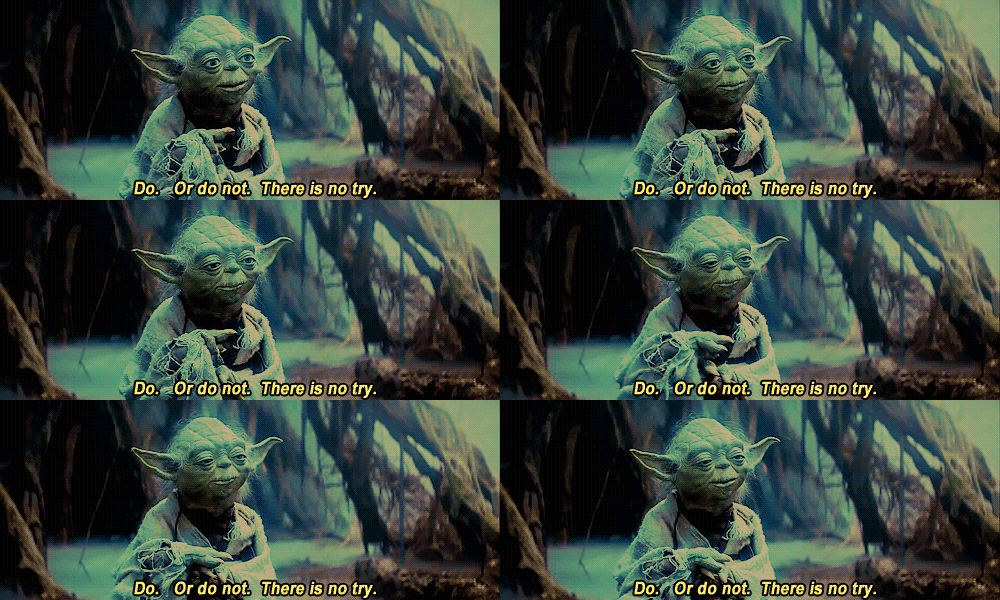
I have to be honest: there are few things I hate worse than “trying” to do something. “Trying” to do something is pre-excusing defeat. It’s a way of trying to insulate yourself from pain. It’s an attempt to inoculate yourself from having to take ownership of the fact that you failed. It’s not your fault. You tried.

The problem isn’t failure – the problem is trying to not admit that you failed.
There is nothing wrong with failure. We all fail. It can be frustrating – maddening even. We can put 110% of our soul and effort into something and still fuck it up. We can fail at things we know to the core of our very beings that should have succeeded. But the difference comes in whether we accept that we failed or whether we try to excuse it, justify it or rationalize it away. It’s tempting. God knows it’s tempting – saying “I tried” is a way of preserving our ego and sparing ourselves from pain.
But it also means cheating ourselves of the opportunity to grow.
The Cold Truth of “Forever Alone”
Let’s acknowledge a hard truth: some people are forever alone. Sometimes there isn’t someone for everyone. People die having never found romantic love or a “successful” relationship. Anyone who says otherwise is selling something.
Now that we’ve acknowledged that, let’s acknowledge another hard truth: nobody knows if that’s going to be them. The fact that some people never find love is no excuse for giving up. There is literally no way of knowing whether or not you’re going to be one of those people until you die. Nobody knows which moment is going to be their last; you could be hit by a bus tomorrow, you could have a cerebral hemorrhage 40 years from now. You could literally be on your death bed and find love even at the very end. The fact that we don’t know when or how we’re going to die means we have an obligation to live in hope.
Using the metrics from my Facebook page as a representative sample, the majority of my readership is between the ages of 18 and 34; are you really trying to tell me that you know with full certainty that you are going to be spending the next 40 to 60 years alone and unloved?
It can be frustrating beyond words to feel that way; I know exactly what it’s like. I’ve been there myself. If you asked me 20, even 10 years ago whether I’d be where I am with my love life, I would have laughed in your face… probably while crying. Your current situation is no guarantee of how your future will be and to assume that it will always be thus is just one more way of ceding responsibility.
The Only Easy Day Was Yesterday
This is not to say that changing your life is as easy as waking up one day and declaring “That’s it! My entire life is my own responsibility!” and then things are magically rainbows and blowjobs for all.
I’m not saying it’s easy. I’m not saying that everybody is starting from the same place. I’m not saying that chaos and random chance don’t exist and don’t affect you. But accepting responsibility for your life, internalizing the locus of control means fighting to change things, even in the face of failure. Even in the face of repeated failure. You may not have control of everything that affects you, but you and only you can choose how to respond to it.
Some people will have an easier time of it than others. That is a part of life. You will have it easier than other people will. This is also a part of life. It’s going to be a struggle. And it’s going to suck. This is unavoidable. One of the wisest people I know once told me “Pain is inevitable. Suffering is optional.”
It was in taking responsibility for my life that I was finally free to improve. By puting the onus on me to fix my life – to fight towards becoming the man I wanted to be – I was able to start breaking through the self-limiting beliefs and change my life.
I want to close this with something I’ve listened to when I needed to remind myself of what was at stake.
You’re better than that.




Fucking hell, that was some very uncomfortable reading, actually describing me down to the level of individual relationships (the poisonous relationship, the amazing geek girl that left me). I think I'm at the less extreme end, and am certainly careful to never subscribe to woman blaming or other implicitly or explicit sexist crap, but thanks for reminding me that actually *I* have a problem and a need to sort it out.
I don't think I'll ever stop being a little angry at the world, after all people (*people*, not women) are stupid and awful and irrational – in the love lives as in everything – but it's pretty clear that I need to stop using that as an excuse for my failings or seeing it as an insurmountable barrier to certain kinds of success, because it's not.
So yeah. Really great piece and site. Thanks.
First, I agree with the 'locus of control' in a major way. This applies to all aspects of your life, not just love-finding.
However, I disagree slightly on the try. Yes, I disagree with Yoda. Actually, I disagree with the way people interpret Yoda. I think they tend to over-simplify and lose a little definition in the process.
I think trying is a step up from doing nothing. From those who come from doing nothing, trying is improvement. The point that some people make is that trying is not enough, and therefore one should not 'try' at all, which I think is over-simplifying.
I think the point of Yoda's quote ("Do, or do not. There is no try.") is that of accepting responsibility as well. You either did something (that either succeeded or failed) or you didn't do anything at all. However, most people are so success-oriented that they think of failing as a "did not" and therefore put the 'try' in its place to feel better than a 'did not succeed.'
The true 'did not' is when you didn't even try. When you try, you're doing, and you accept responsibility for that, succeed or fail. If you succeed, you did something that succeeded and did not do something that failed. When you fail, you did something that failed and did not do something that succeeded. That is the point Yoda was making.
I think a lot of people oversimplify the 'never say try' and lose a bit of definition in the process and shift away from the point of the quote. I don't think there's anything wrong with 'trying' unless it's used as an excuse to avoid the responsibility of failure and shift the locus of control. If 'try' is being used as "I did everything I could do, the results were not my fault" it is wrong, and avoiding responsibility. However, when used as a defense against not trying at all, it is a legitimate defense.
So in the Daniel Radcliffe picture (which I have no idea where that picture came from and know nothing of the background, just taking it at face value) where he says "Nobody can criticize me for trying" I agree with that. Trying is doing something. They can criticize him for not succeeding but they can't criticize him for trying. He is actually accepting responsibility for the fact that he tried instead of denying responsibility and using that he tried as an excuse against why he didn't succeed.
One could say "At least I did something" as a defense against accusations of inaction instead of "At least I tried," so it is possible to over-simplify and just remove 'try' from the vocabulary altogether. But people use 'tried' all the time and it's okay when used that way. But against accusations of having not succeeded, you can only say "You're right, I didn't succeed" and the defense of "But at least I tried" doesn't apply. It's when 'try' is used in the latter way that it's used inappropriately but I think it's oversimplification to say never use 'try' at all because I feel it's appropriate to use in the former way.
That's my thoughts anyway.
Also, there's a short quote that is very literal and very motivational and is all about responsibility and locus of control. You've probably heard it before. "Give me the serenity to accept the things I cannot change, courage to change the things I can, and the wisdom to know the difference."
In this blog, the Doc is touching on all three aspects of that little speech. There are some things you can't change (example: "The Cold Truth About 'Forever Alone'"), there are some things you CAN change (example: "No More 'I Can't'") and the Doc himself is trying to offer you the wisdom to know the difference in the entire blog.
Listen to this blog. It's good advice.
I agree; I don't really see "trying" as a way to insulate yourself from pain. Trying only means that you're not absolutely sure you'll succeed. That is quite normal when interacting with other people that not all things go your way. Most of the time trying is all you can do. Sure, you can tell yourself over and over that this time you'll succeed – but unless confirmation bias or real confirmation weights you down so heavily that it actually affects your performance, you're still only trying
.
The real problem starts when you constantly try and fail thus suffer the consequences every time for yourself and only yourself. That's why you're shielding yourself from pain in the first place. Not everyone can take the rejection all the time and still walk on. By accepting that the place where you now stand is entirely your own doing is not something many people can stomach. Nor can most people stomach 15 times "no" in a row. I know I can't, but I think this is asbolutely normal.
I think the point of the Yoda quote is that "try" is not an end. If you are faced with a challenge, you try to overcome it, and one of two things will happen. You'll succeed, or you'll fail. If you succeed, great! If you fail, you have two options, try again, or accept defeat.
Try is never the end game. Try is the means to the end game. Saying "I'll try" is not committing to the end game. You are not committing yourself to success, and you're not acknowledging possible defeat, so it serves no purpose.
It's like saying, "I'll walk." Great, to where?
I'll try… Fantastic, to what end? The real question is how much fight do you have in you against the obstacles in front of you?
I don't mind the Radcliffe quote, because that is a right with the world acceptance of defeat. What he is really saying there is "I have accepted my defeat, so criticizing it is pointless." At least he acted and tested the boundaries.
So, how much defeat are you willing to accept in your life, and how much try do you have in you?
Those with astounding lives have a large stamina for "try."
Great article BTW and it falls in line with my personal philosophy. You are defined by what you do.
I want to address the forever alone thing, because it touches on something I find very frustrating. It is the equasion of not being in a romantic relationship with being alone.
I have had a lot of romantic love and great sex in my life. Currently, I am single and have been for a while, by my choice. But I am not alone. Because I have a rich and full life, complete with friends and family. I like who I am and feel connected to a community. So I am not alone. If I died tomorrow, currently single. I wouldn't be dying alone, I'd be dying with really great people in my life.
Additionally, there was a time when I was younger and due to poor self esteem was dating a really abusive woman…and you know what? I felt really alone even though I was dating. And it feels really terrible to feel forever alone *while* you are dating someone.
To dovetail into what DNL wrote, Feeling alone or alienated is something you need to own. You need to learn to feel comfortable with being by yourself. To be by yourself without being alone. You need to learn to feel connected to community, to not feel alienated, whether or not you are dating someone.
Exactly right.
"Giving up" on finding a romantic relationship need not be the admission of defeat that it might appear. Making a decision to prioritize other aspects of your life is not an equivocation.
Thirding the above comment, and adding that prioritizing other aspects of your life and being fulfilled without a romantic/sexual relationship can take the pressure off dating and make the whole process easier and more likely to be successful.
Of course, if you don't live near family you love or old friends that you're comfortable with, creating this non-romantic community can be difficult as well, but at least there are less variables in finding one that works.
A million times this.
It is possible to be happy, complete and fulfilled in yourself, and in fact, I don't think you *can* be a good partner if you "need" to be in a relationship. I am with my partner because I choose to be, not because I need to be, and I want whomever I'm with to be choosing, every day, to be with me, not doing it out of loneliness or fear or need.
Am I the only one who cringed at the last sentence in the video?
"Your better then that."
Grammar Nazis should probably listen to that video without actually watching it.
I'd probably shift the emphasis away from "hey, it's your own damn fault", as I think there are decent, worthy, deserving guys and girls who are doing all the right things and still getting nowhere (which the Doc kind of recognizes in the 2nd half of this post), and instead emphasize that whether or not you're to blame for your lack of success, you can't allow yourself to sink in self-pity and bitterness and victim stance. Keep putting yourself out there, keep working on your awesomeness, show them how crazy they would be to not give you a chance, and having a fun and fulfilling life will be its own reward until you can find someone equally awesome to share it with.
(I recognize that "deserving" is in this context a loaded word, as it reeks of entitlement and "I have two arms and I bathe sometimes, why aren't women throwing themselves at me", but I still think that the word has some value – even if the dynamics of finding a partner are all about supply and demand and not whether you *deserve* it, I still think there is such a thing as a great, caring, supportive romantic partner, as well as some truly shitty – undeserving! – ones)
The problem comes from the great stress on romance and sex in modern Western culture. Romantic love is seen as an absolutely essential part of life. Its one of the ways the West likes to define itself against other cultures, rather than arrange marriage we marry for love. We court, we date, we kiss, and we hug and hold hands. Similarly, sex is depicted as the supreme ultimate pleasure rather just one form of pleasure. Nothing is supposed to more fun than sex. People who haven't experience either romance or sex are often depicted as being off in some way.
If romance and sex were downplayed more and if their importance was not stressed than people wouldn't really feel that they deserve either or at least would less anguish and pain from the lack of either. This doesn't mean that we should return to the days of virgin worship, those had problems, but rather that romance and sex should be seen as equal to other types of love and fun rather than as the supreme versions of them.
The problem of decent people doing all the right things and not getting the results is that the other party is plagued by caution, doubt, and reluctance. In short, the party that is responding to the interest isn't taking responsibility. Sometimes they simply aren't interested. Other times they are plagued by doubt, reluctance, hesitation, too specific standards, and unrealistic expectations..
Most of the time they simply aren't interested. People are allowed to have specific standards. People shouldn't have to lower their expectations just because other people think that they're unrealistic and too high. If they'd rather wait for what they want then settle, good for them. There's no need for you to judge them on that.
There is a difference between having specific standards and flatly unrealistic standards. Its okay to have things you are looking for but not to pursue a relationship with a person who has standards A, B, and C but not D reflects thinking poisoned by Hollywood. This is especially true when the lacking standard is something beyond control like height.* Just as Doctor Nerd Love doesn't believe in the One, I don't believe in the perfect partner. Chances of meeting somebody who fulfills all your desires, needs, and wants is not very likely. To reject somebody who comes close after one date is moronic.
I guess it depends on your idea of perfect and your idea of high vs. unrealistic standards. I believe that I have extremely high standards but I don't believe that they're unrealistic. In fact I know they aren't because I have a partner who does fulfill all my desires/needs/wants and I see him as perfect. I am aware of his flaws but that doesn't stop him from being perfect to me and me to him. And I would have completely missed the opportunity to be with him if I had settled for anything less or listened to all of the naysayers who told me that I should.
It's incredibly unneccessary to call someone moronic for rejecting someone after one date when it's completely their call. Stop making assumptions and judging people.
Am I the only person who thinks that unless the first date is bad than you should try for a second date? The idea that you could tell whether or not you want to be with somebody or any amount of time after a couple of hours is foolish because it take time to get to know people. Just because there is great "chemistry" on a first date doesn't mean that two people make a great couple and the absence or only average amounts of "chemistry" doesn't mean that you will be a bad couple. Some people, including myself, are acquired tastes and take awhile to get to know.
Where did the concept of chemistry even come from? It can't be older than the 1920s. Its something that romance novelists and Hollywood scriptwriters invented to get relationships moving faster than they would in real life.
And also, in what sense is a person who is willing to give people a second or third try judgmental while a person who makes a decision after an hour non-judgmental.
Because you'er judging people who aren't willing to do the same, and it's their call, not yours. I don't personally have an opinion on the correct amount of dates one should have, coz I don't date at all. I like to let relationships form naturally without any of that kind of pressure. But I don't dictate to other people how they should date, or judge them for their personal decisions. No one is under any obligation to continue seeing something that they aren't 100% keen on seeing, and it's not right for you to call them moronic just because they don't have the same opinions as you. Some people only need one date to make up their mind, and you have no right to tell them that their decision is wrong just because it's not the decision that you would have made.
Oops. *you're*
At the end of a date, the question any person is going to ask themselves is, "Do I want to spend more time with this person?" It doesn't have to be a clearly "bad" date for the answer to still be no. If you've spent two or three hours one on one with someone, and you feel no interest in doing that again… why should you make yourself? There are so many people out there, it seems to me it makes more sense to hang out with someone new than to spend more time with someone you just weren't clicking with. I don't think most people expect to be blown away but sudden instant chemistry, but they do expect to at least be looking forward to seeing the other person again before they'd take that step.
And honestly, I think this is *more* fair to the other person. I suspect that the vast majority of the time, if someone didn't catch your interest in a few hours of one-on-one time, spending another few hours with them isn't going to change that. But in giving the other person that "second chance", you'll have raised their hopes and made the rejection more intense when you end up turning down that third or fourth date. And you also (especially if you're a woman) risk the other person getting angry at you and accusing you of leading them on.
If you're the sort of person it takes a while to get to know, you're probably better off not doing a lot of cold dates (where you're meeting someone you've hardly talked to before), and letting people get to know you in group settings/online/etc. first so that when you ask for that one-on-one date, they'll already have a pretty good idea whether they'll enjoy spending that time with you.
No one owes it to you to give you more time to show how awesome you are, especially when they've already given you a one date to do that in. (They could have said no to the date in the first place, remember.) But conveniently, you don't owe anyone else your personal time and energy either!
My ususal response to, "do I want to spend more time with this person" is usually yes. I look at the full picture and if a person fits most of what I'm looking for, I'm willing to go another date one to give it another try. A date has to be really unpleseant for me to say no to another one. I'm also skeptical about chemistry. Its a part of our romantic mythology that I don't buy into for reasons I outlined above.
Finally, I've done ice cold dates, dates where a person got to know more a decent amount of time in real life or online first, meaning a month or in the case of my ex-5 years, and the results are the same. That I'm a blank positive adjective blank noun for male human but they didn't feel any chemistry. Now I know that chemistry can be cultivated but its very hard to mantain the dual requirements of safety and chemistry cultivation. Especially when you are on a thirty minute to an hour time limit. I favor ice cold or relatively cold dates because I have time in my life now for dating and prefer to be in a relationship when I have time rather having to juggle everything with a calendar book.
Well, keep in mind that just because *you* would usually want to spend more time with any given person, many people are much more picky about who they spend time with, especially one on one, because they have a lot of other commitments, or they're not very social in general, or whatever. And that's okay. If they honestly don't feel any desire to spend more time with you, would you really want them to pretend they do?
You also might keep in mind that "I didn't feel any chemistry" is a very easy excuse that could cover a myriad of reasons (quite possibly different reasons for each person!) why the other person said no to a second date. I've used "I just didn't think we clicked" or similar when I had a very clear idea why we didn't click–but when you tell someone that something about their personality is incompatible with yours, or that you find them physically unattractive, there's a high possibility of them getting defensive or feeling insulted, so it's usually easier to use a catch-all phrase that doesn't lay blame.
I might be approaching dating and romance differently than most people, only about three people I know in real life agree with me on this, but I've never been on a date where I felt that there was a click and only two or three dates that were completely unpleseant. Nor am I really looking for a click since its not necessarily a reliable sign. Generally, my position was this was fun and we have at least some things in common. Looks are usually the last thing I take into consideration.
I know that nobody is obligated to give a second date. However, I am allowed to question the dating system and romantic mythology as currently constructed and point out what I think are its structural defects. Just because I participate in the system; doesn't mean that I have to like it. Ideally, I think that unless a first date is that you should usually give the other party another chance if the date was at least average.
One of the issues I'm having with your reasoning is that you are assuming that the reason people aren't taking a person up on a second date is because of romantic mythology.
In my case (and I suspect a lot of cases) it certainly isn't because of romantic mythology that I generally put the kibosh on. I might say, "No chemistry, we didn't click" to be polite, but if I don't ask you out on second date it is probably because you have failed to meet one of my non-negotioable standards. I have soft standards (or "nice to haves"), but I have hard standards and I'm going to try to find out about them on the first date. And if you don't meet those standards that are non-negotiables for me? You aren't getting a second date. I don't care how average the date was. That has nothing to do with romantic mythology.
Now, it might make you feel better to blame your date for having "unrealistic standards" or for falling prey to "romantic mythology" in order do make yourself feel better for not getting a second date…and sometimes that may even be true…but I bet it isn't always true. I bet sometimes the date didn't go as well for them as it did for you.
Lastly, if we have an average time on our first date, you aren't getting a call back. I don't hang out with non-romantic people I only have "average" times with unless I'm forced to for work. The people I hang out with I have good to great times with. I have a life full of people I have awesome times with–who make me feel great after talking to them and who I make to feel great. Life is short, and I'm not aiming for average. I certainly won't have lower standards for my romantic life than I do for my friendship life.
There's sexual chemistry, which I agree isn't necessary for it to be worthwhile to see someone again, and then there's a different type of chemistry — whether you enjoy being with the person or not. I didn't feel any sexual chemistry with my boyfriend when I met him, but I enjoyed hanging out with him, and the same is true with all of my friends.
If I've already invested 2-3 hours doing dinner with someone, and I haven't enjoyed myself, why on earth would I come back for more?
This has nothing to do with "romantic mythology," and everything to do with knowing what the people you like being around have in common and being able to spot it — or recognize its absence.
(In addition, "hey, I just didn't feel we clicked" is a polite, no-fault way to tell someone you didn't like that you don't want to see them again.)
Time is a finite resource. It's what life is made of. If someone chooses not to spend more of that finite resource with one person and instead wants to use that finite resource for something else, that is a valid choice. To say that if another person spends one date's worth of time with you means that they should spend more time with you suggests that you think they owe you something. If everyone felt that way, then I think there would be a lot fewer first dates, because people would be cautious about getting into a situation where they owed someone more time than they wanted to spend.
"Am I the only person who thinks that unless the first date is bad than you should try for a second date?"
I think that here you are mistaking "I would prefer people to do this" with "people should do this". Your preference is totally valid, but it does not create a "should" for others.
I couldn't care less about the concept of sexual chemistry, but there is something to chemistry in general. All my friends are people with whom, the first time I hung out, something just clicked, and I knew I liked and was comfortable around them.
Given that I feel a connection with about half the people I meet, why would I waste time going out a second time with someone with whom I don't? Even if I can't put my finger on why I don't feel warmth toward them, why bother?
However, no one is obligated to date you and people can be what you call moronic if they want to. So, I am super awesome, but someone won't date me because I'm 5'6"…oh well. That person's loss. If I think that person truly has unrealistic standards the only recourse I have is *not* to badger them into dating me or raging against the world for being unfair, but knowing they'll just have to deal with the consequences of their "unrealistic" standards, which includes not being able to date me.
And really? If I hit on someone who says they won't date me because they don't date black people, or guys under 6 feet, or guys that make less than $100k/yr, or whatever…you know what? That is good because I don't want to date someone with those standards or values.
I have high standards. Some people think my standards are too high…mainly because they don't value the things I value. For example, I won't date a person who votes Republican. People for whom politics is not important will say that my standard is ridiculous. But politics are really important to me…and I won't date someone who votes for politicians who work to deny me access to the same civil liberties as other people. That is a deal breaker for me. I have other deal-breaker standards that are particular to my values…and I don't care if someone thinks those standards are too high. I get to make my standards for dating, and then I deal with the consequences.
My two were people who smoke, and are allergic to cats. I decided I couldn't ever date someone who had either of those things. Some people say that is shallow and whatnot, but the smoking ban was for my personal health and comfort, and I knew I would never be happy in the long run if I had to abandon my pets for a guy.
It was the first question I asked my now hubby.
Basically, someone's standards might not be the same as yours, it doesn't mean they are wrong for sticking to their guns.
This is why I think that claiming that someone's standards are "high", even if you're referring to your own standards, is rather inaccurate a lot of the time. I'm sure we can find a much more suitable adjective, like "different".
I find this quite amusing because I am a non-smoker and my partner smokes, and he is a crazed cat lover and I am allergic to cats. I don't think your standards are shallow by any means, they make total sense.
One of mine is that he can't be scared of spiders. Because I am absolutely insanelyTERRIFIED of spiders, and if we're both scared, who the hell is going to kill it/get it out of the house? There was this guy I was seeing, and one night at his house I went to the bathroom and there was a GIANT spider in there. That's when I found out he was also terrified of spiders. And I knew in that moment that we would just never work out in the long run.
It might sound shallow to some people, but really it's practical. Otherwise you end up having an hour long hostage situation in the bathroom with two people terrified of one spider.
True, and I can say I developed those two criteria after dating a guy that smoked and was allergic to cats. I decided never again, I don't care how awesome the person is, because those two things made me miserable in the relationship.
As far as expectations from potential partners, realistic or otherwise, you're dealing with 3 things:
1. What people are looking for in a partner
2. What they *say* they're looking for in a partner (like in a personal ad)
3. Who they end up choosing
Those 3 things have a way of being very different from one another.
I understand what you're saying about how it's going to suck, and it's going to be difficult…. But sometimes it also just seems impossible.
I have spent my entire life being self-examining, to the point of social paralysis. I've read dozens of books, thousands of articles on do this, do that, this is correct, this is wrong… and yet I'm still no better off than I was. In some ways, I'm WORSE off, because I'm even more confused about what I should be doing.
It's just… exhausting. It's bad enough to try and fail, but it's worse to try, fail, and then be told it's still completely your fault for failing. If there IS such a thing as people who are going to be "alone forever," then it logically follows some people are just inherently unattractive, no matter what they attempt. Isn't there any easier way to identify if you're one of those people, so you don't spend your entire life trying and then being blamed for failing?
Key word there: seems.
So what is a good way to identify if something SEEMS impossible, and if something IS impossible? Do I have to spend the rest of my life trying more and failing, before I finally have permission to say it IS impossible? Isn't there a short cut to identify those people who are just.not attractive?
The whole "there are people who just aren't attractive" is a red herring. Not all relationships are based on sexual attraction. Some people date others not because they find them sexually attractive, but because they would make an amazing parent. Some people appreciate their politics, their brain, their religiosity, their…whatever.
There are many different ways that people choose to pair up. I'd say that if you find that you have some value, you like who you are, there are people out there who are going to be down to that thing…now I don't know if you will find those people attractive in return. Because it does take two to tango. You shouldn't only be thinking–will someone find me attractive?, but also–these are the things/values/etc that I find attractive…these are things I want in a relationship…do you know those things?
Also, there isn't universal attractiveness. There are people that think supermodel A is universally attractive…but lots of people don't find the supermodel look attractive. A lot of people will say that no one can find pudgy bald dudes attractive…but there are lots of folks who do find pudgy, bald dudes attractive. If I meet someone who dresses well and has symmetrical faces (or whatever) but I find out they voted for person X in the last election…or they don't vote at all…then I just won't be able to find them attractive. Beauty is in the eye of the beholder, as they say.
If someone ends up forever alone, it isn't because they aren't good-looking, it is because of other elements. I many of those other elements might need to be dealt with through therapy, but they can be dealt with.
Well I meant "attractive" more in an overall sense, than a physical sense. Like, the entire package is not attractive. Like I said in my previous post…. what if someone is just annoying? Or very intense? Do they really have to spend thousands of dollars on therapy to fix something that isn't even necessarily bad, but is fundamentally unattractive to people?
To be really lame, I remember the episode of "How I Met Your Mother" where he was dating a girl who was beautiful, smart, funny, appreciative, but she talked a LOT. To the point that no one wanted to be around her. It just made me feel rather sad for her… she wasn't a bad person, she just had this annoying characteristic that it was suggested would make her single as soon as somebody noticed it.
Attractive is even still relative.
Let's address the issue of being intense and talking a lot. I am intense and I talk a lot.
But let's note: "talking a lot" can mean a couple of different things. While I talk a lot, I don't talk over people, and I listen to what other people say. This isn't a general problem that needs fixing, because while some people won't find that attractive (like one ex of mine), others will find that especially attractive (like everyone else I've dated). Some people, when they "talk a lot" are not listening to others, are talking over and disrespecting others, are forcing people into conversations they don't want to have…in other words they are harassing other people. This is a problem. This is being a jerk. If "who you are" is being a jerk, or to put it another way, you enjoy stepping on other people's boundaries and making people uncomfortable, if your ability to hurt other people is more important to you that being a better person, then yeah maybe you'll be forever alone…and I hope so…because that sort of person isn't a healthy person to date.
On the issue of being intense. I am intense because I feel strongly about things and I live live with passion and enjoyment. Some people have found this intimidating, but most people I have dated have dated me because of my passion. But, when some people say "intense," they mean that they are controlling and needy and clingy and paranoid and unhealthy. One is cool and will not actually harm your dating…the other is a pathology at will harm your dating and should.
You have to ask yourself if you are the healthy or unhealthy "talking a lot" or "intense." If you are the unhealthy kind, then I recommend becoming the healthy kind. Note: I'm not saying "stop talking" I'm saying talk a lot in a better way (which includes good listening skills). If you are the healthy kind, then I recommend finding a social circle that values talking a lot and being intensely passionate about things…and those people are everywhere. Not being able to find any people like that might be an indication that you are doing your thing in an unhealthy way rather than a healthy way–in case you are in high school…which just sucks, and I'll tell you you'll find you tribe after high school.
I'm going to give you an example. I like to "over-analyze" media. (I like to think of it as analyze rather than over-analyze, but you get the idea). There are people who find this annoying and "ruining the fun of the movie"–but analyzing media is actually very important to how I am in the world. So, those people who don't interact with media intensly and analytically? There is nothing wrong with them, but I don't date them and I don't go to the movies with them. And because I know that they don't like that sort of thing, I don't talk to them about media–because it will annoy them, and I don't like annoying people. And because this sort of thing is important to me…they will never be all that close to me. On the other hand, because I like analyzing media, I got my PhD in Musicology and now I am surrounded by people who are just as intense and analytical about media as I am. So now I spend my days having conversations for hours and sharing intense analyses with like minded people. People tell me theirs and I learn new things, and I tell them mine and they learn new things…we talk together and we work out new things together. It is awesome, and people find the way I think about Aretha Frankln totally hot.
People who don't take music analytically or intensely are not compatible with me and I am not compatible with them, because an analytical turn of mind is a core part of my personality. But because I engage in media analysis in a nonpathological way, I have lots of people I am compatible with and I don't annoy people. On the other hand, every once in a while I'll run into a person who is pathological…they are bullies, they don't listen, they talk at and not with…the problem with them is not that they analyze media, but that they are conversational bullies.
If you don't have pathological habits, then the problem is probably the people you choose to hang out with are incompatible with you, so you should find people who are compatible with you and your values. If no obe in the world is compatible with you, then you probably have something pathological going on. If you have got pathological conversational habits, don't abandon talking, but learn how to talk in a healthy way–that isn't "changing who you are."
Well I do talk over people…. but is that healthy or unhealthy in a context where if I never talked over people, I'd never talk, period? Now maybe that means I have nothing interesting to say and no one wants to listen to me, but I like the things I have to say. How can I talk without talking over people, when no one wants to listen to what I say?
I also over-analyze (analyze) things, and people around me find such topics incredibly annoying. But I can't find an environment where people DON'T find such topics annoying. I am in a "niche" of things I find interesting and want to analyze, which no one else does. So, do I just never talk about things that interest me?
This kind of goes back to my original question; what if I am just not compatible with, well, nearly anyone? Do I completely change my interests, my personality and the way I process the world to become compatible? How do you decide between what is "healthy" and what is not?
Generally, talking over people is considered rude. The polite way to enter a conversation is to wait for a pause (just an end of sentence will do if you want to say something short, end of story if you have your own whole long response in mind), then say your piece.
Also, are you hijacking the conversation with topics you want to discuss? If they're sharing "annoying sibling" stories, it's the wrong time to leap in with an in-depth analysis of the life-cycle of the cicada. If people are telling wild bug stories, then it could be.
It's not about changing your interests or who you are. It's about learning how to hold a conversation and share your interests in a polite and respectful way. It's not betraying your concept of self to respect when others are speaking, it's respecting their selves as equal to yours.
Frankly though, if none of your friends share any of your interests, why not find new groups of people who do?
I find that there are very different cultural expectations of when to enter a conversation. Some people wait for long pauses, some wait for short pauses, and some jump right in. I come from a long pause background and have had to learn the hard way how to have conversations with people from a jump right in background.
Why do you think that changing the way you talk is a complete change of personality? Surely there are more aspects to your personality than "talks over people". For instance, I don't think you've actually said what your interests are (and I'm willing to bet real money that there is at least one other person out there with at least one of those interests).
That said, if someone isn't interested in listening to you, you could talk over them with a megaphone and they still wouldn't be interested in listening to you, so when you do talk over them, you're really accomplishing diddly squat. Whereas if someone is interested in listening to you, they should give you a chance to talk to them without you being forced to talk over them, and that is the right time to talk to someone. Try to remember that, as much as you like your interests, the conversation rarely if ever revolves around you.
Sure, conversations don't revolve around me, but I sure would like them to INVOLVE me. I try doing the whole "wait for a pause," but with my social circles, there IS no pause. People just… force their way into talking, and the most entertaining/popular person gets listened to. So, if there is no pause, and I can't talk over people, do I just sit there quietly? (I have tried this a few times. I literally sat there for 2 hours without saying anything, and no one noticed.)
I guess it's less that I don't have similar interests to people, and more that people don't think I have interesting things to say about those interests. And that doesn't change irregardless of who I hang out with.
I've found that people like me best when I share absolutely nothing about myself, and keep the entire conversation about them. (Ask about their interests, about themselves and their experiences. Absolutely no statements, all questions.) So, I guess I COULD be well-liked, if I insert absolutely nothing of myself into the conversation. Is that worth it?
And if nobody thinks I am interesting, and no body wants to hear me talk, doesn't that equate to being unattractive? So aren't I one of those "forever alone" people?
You are not one of those "forever alone" people unless you want to be. Because it can not be true that *nobody* in the world will think you are interesting and that *nobody* in the world will want to hear you talk.
So there are a couple of things I'm going to tell you, and you can take them or leave them.
1) These people you are hanging out with are not your friends and I don't recommend investing much more time and energy with them. If they aren't noticing that they are shutting you out of conversations for two hours, you don't need to be spending time with these people. Find people who are better for you to interact with.
2) I think you need to learn how to communicate better. Talking over people or not talking at all (or not talking about yourself) is not communication. Some of the problem seems to be the terribly rude people in your social circle, but some of it is also your responsibility. Let us say that your interest is decoupage. And let us say that no one is interested in decoupage so they aren't interested in talking about it to you. Then let's say you have found decoupage fans…and none of them…even those people who are really invested in decoupage…are interested in what you have to say…it probably isn't what you have to say it, but your skill in communicating what you have to say. Communicating is a skill that you can improve. Perhaps you could try toastmasters or public speaking classes.
3) What I am hearing you communicate in these posts is a lack of self-esteem. I think you should work on that. Working on that will make other things easier.
Couples also don't need to share the same interests. I'm active in the dance community. There are lot of married amateur and professional dancers whose spouses aren't interested in dance at all. These are people who love to dance, who spend at least a couple hours a week at dance lessons, and go out dancing for fun. For the professionals, their life revolves around dance. However, their spouses aren't interested in all at dance.
Do they really have to spend thousands of dollars on therapy to fix something that isn't even necessarily bad, but is fundamentally unattractive to people?
Have to, no. Like just about everything in life its a trade-off. Is it worth letting go of this part of yourself to get along better with people? That's not a question with a universal answer. Staying the same means a smaller dating pool but if you're ok with that, its your choice. Just be clear that it is a choice, that there are things you can do to change you situation if you want to.
My advice? Just try to be nicer to people. I'm not saying you're a mean person, because I've never met you, but I believe that just about everybody in the world could stand to be nicer to others. Don't think "am I being annoying" or "do my friends secretly hate me?" (if they're hanging out with you, they like you at least a little bit), instead think "could I be nicer to the people around me right now?" (hint: the answer is always yes).
And at some point, you're going to have to accept that you won't be able to say everything you want to say, and not everybody is going to be interested in what you're saying. That's fine, because it's true for everybody in the world.
Also, if there's a guy you like, ask him out. Don't wait for him to ask you out (for me personally, a girl who shows obvious interest in me automatically becomes like 15 points more attractive to me). And remember to be nice about it.
But at what point is being nice being a doormat? I've started to resent my friends, because it seems like I try to be nicer (always asking them questions about their lives, sitting there while they go on and on about themselves, lending them money without them paying me back, doing them favors, etc) and never get anything back in response. We can all be nicer, I agree… but at what point does nice become passive?
As to your last point, nope, sorry, NEVER asking a guy out ever ever again. I've been the pursuer in nearly all of my relationships, and each time it's turned out that the guy wasn't even into me… He dated me JUST because I asked him out. I know it goes against some of what Doc says, but if a guy wants, he pursues you. If he doesn't pursue you, he doesn't want you. Simple as that.
These are starting to sound less and less like “friends” and more like “assholes you hang around with.”
Nobody should be pursuing anybody. If you have to pursue someone, it means they're running away.
Based on what you say about your friends, I'm wondering if maybe you don't have a great sense of how people act who are genuinely into you?
There is no chasing with any important people in my life. As Captain Awkward says, people who like you act like they like you.
I definitely agree with DNL. These aren't friends. They are assholes you spend time with. Why do spend time with them? Why lend money to them if you know they won't pay you back? Why even be with them if they don't want to know what's going on in your life?
Better than sitting at home alone? Ya know, the whole "beggars can't be choosers." And the weird thing is, I like THEM. I like them despite having a sense that they don't like me.
But maybe it isn't surprising that the same issues I have with friendships (pursuing friendships with people who don't even seem to like me) are similar to issues I have with relationships.
Do you guys think that a lot of nerds have dating problems that are really just People problems, or do nerds generally do well with friendships and just have difficulties with romance?
Dating problems are people problems. But look, I don't know you and I don't know these "friends" of yours. But they sound really awful. I know you don't want to sit home alone…but all the moments you are spending with these jerks are moments that you aren't finding other people to hang out with who aren't assholes who take advantage of you and disrespect you. I really recommend cultivating different friend networks as soon as possible.
Also, I do think you should still consider asking guys out. I don't think you should only wait for guys to make the first move. As Nina Simone said, You must mold and shape your future or it won't be molded and shaped at all. You don't want to be subject completely to the whims of chance or other people do you? I mean, take some agency! Sure, you dated some guys who only dated you because you asked them…but guys go through the same thing all the time. But you don't have to think about that right now…because right now I think the most important thing for you (if I were you) would be to get out of those toxic "friendships" and find better people.
Oh and also? Asking someone out doesn't have to be this big deal. I ask people out all the time on a platonic level. I say, hey–do you want to grab lunch sometime next week? I do this with people I'm interested in romantically and people I'm not interested in romantically. A "date" is just hanging out with someone and getting to know them better to see if you want to do more than that.
And this is important: you keep talking about how people mistreat you and you still like them. You deserve better treatment. Get higher standards. People don't get to be in *your* company if they aren't treating you well enough. Nobody gets to date *you* if they don't meet your standards. You aren't a beggar for love or friendship. You are a valuable human being who deserves to be treated with respect. You deserve people in your life who are interested in the things you say, that think your passion is a virtue. You deserve people who honor you and look out for you. But people won't honor you until you honor yourself. One way to honor yourself is to stop hanging out with these assholes who are disrespecting you.
"sorry, NEVER asking a guy out ever ever again."
You are certainly free to make that decision, but you will have to accept the consequences. Rejection is a part of the dating game, no matter who is "pursuing."
Also, you're last point just isn't true. I know from experience; there have been plenty of girls I've "wanted" that I didn't pursue.
I agree with Max.
In addition, I'm a pro-feminist egalitarian guy who really dislikes all those sorts of sexist antiquated ways of gendered interaction. So if there is a woman who seems like she might be interesting, but she starts pulling out all of those Cosmo "sends passive aggressive signals but never make a move" tips…I'm going to get really not interested, really quickly. And if I were going to ask her out before, I certainly wouldn't after.
I date people who know what they want and do not have a problem articulating that respectfully. I date people who will be my equal, and that also means equally willing to put themselves out there when it comes to asking people to coffee.
First, I really don't like using the word nice to refer to people or actions. Nice refers to things like nice car, nice house, or chair. People are kind, or gentile, which comes with a less loaded vocabularly than nice. Nobody talks about the problem with kind guys on the internet or real life.
Second, do not confuse kindness and gentleness with passivity. Kindness is about not being harsh to people, not mocking them, giving aid when they need, and generally being polite. This doesn't mean you have to be a pushover. Make your desires, wants, and needs known but don't be abbrasive about it and be open to negotiation and compromise. If you have a special advantage like its your birthday party and you decide how you and your friends are celebrating it than do it. (Unless your friend's are planning a suprise party. Do those happen in real life?).
Nope. My old boss was fat, had buck teeth, no neck and eyes that bulged like Dennis Wolfberg’s behind his Coke bottle glasses, and the entire time I knew him, he was on a path to reconnect with his ex-wife, who I would describe as “modestly hot.” The first time I met him, the phrase “ugly stick” sprang immediately to mind — he remains, and I say this as someone with tremendous personal and professional respect for him, the ugliest son of a bitch I’ve met in person — and yet, he had not only gotten together with a woman conventional wisdom tells was way out of his league, but was getting back in her graces after a gambling addiction and whatever else broke them up. If a woman could see past all that and consider taking him back, there’s hope for everyone.
I like to think of it like this: imagine the ugliest person you know. Now imagine what that person's parents were like. Now, remember that despite those two people being like they were, they were still able to find someone who loved them enough to raise a child together.
Or speaking differently, just look at the couples around you. If you do you will find all sorts of people not traditionally considered attractive in romantic relationships. Sometimes its with another not traditionally attractive person and sometimes its with an average to rather attractive person. Looks help in establishing surface interest and initial contact/apporach since people can't read minds but they are probably relatively little in importance when it comes to forming relationships. This is another reasons why I'm skeptical about the notion of chemistry.*
*Chemistry is my biggest pet peeve about current romantic culture.
is IS exhausting. But I'm 42 years old, having sucked at this stuff for most of my existence, and am newly engaged to someone who is an absolutely amazing match for me.
There isn't a way to say what category you're in. There's going through the motions of 'trying' the same way all the time, every time, and getting the same result; there's going out there and hoping you'llget lucky; there's taking a break (sometimes a really long one); there's waiting for someone else to do the work; there's getting out there and looking. There's giving up and there's moving on.
The thing is, trying to categorize yourself like that? it's, again, externalizing the locus of control. You are who you are and you get to choose what to do about that; anything aside from that is exhausting, liberating and possibly beside the point. Maybe it would be so much easier to know the end before we started, but I'd never ruin the pleasure of reading a novel by starting with the last page, and I wouldn't want to ruin the pleasure of living that way either.
i read all of your comments and wanted to respond because i used to be just like you. i had an annoying personality, weird interests and none of my friends involved me in their conversations. i tried to fix this by being nice, asking them questions as well as sharing my interests – but nobody cared.
what i later realized was that i completely underestimated how annoying my personality was. to me, my annoying personality was obvious to everyone but me. i could not comprehend how actions that were natural to me were annoying to others, but then i bumped into a few people here and there who shared my characteristics, and that changed everything.
once i actually got to see my behavior for myself, i realized how damn obvious it was that i was repelling other people and why my friends avoided talking to me. this became the event that really made me want to work on myself, and stopped rationalizing it as "my personality" because really, nobody wants to be THAT ANNOYING.
if you're curious about what i did to change this, i did some superficial modifications. i got an expensive haircut, i stopped dressing like a ridiculous anime persona of myself, and i got some nice, fashionable outfits.
i also stopped cursing, learned how to speak more eloquently (the key is to practice by simply talking to people and focusing on pronunciation), learned how to be more charismatic (by copying people whom i envied for being charismatic and keeping what i found worked) and generally just tried to not talk so much and instead listened to people and responded to their anecdotes and stories (even when i weren't interested).
i also stopped looking down on mainstream interests and accepted the fact that sometimes people like stupid things, and im no better than they are.
finally, say to yourself, ITS NOT MY FAULT. because really, it isnt. the whole "take responsibility" thing sounds harsh to me, because we grew up awkward because of circumstances we couldn't control. it was never our choice to be awkward, but we can do everything in our power to change it now. and you deserve to be happy (as i know i have become).
a big hug from me to you marty. anyone can become charismatic, and it probably wont take you more than 3-12 months to get there, as long as you admit to yourself that yes, you are annoying, but youre going to change that, and its not your personality, its just behavioral traits that you need to analyze and change.
many hugs.
Relating to choosing to quit: let's say that I am, fundamentally, unattractive as myself (not a stretch, as even my friends don't really enjoy me. Not because I treat them badly, I am just considered "intense" and "annoying" by the average human being.) Should I change myself in a fundamental way to become more attractive? If I know that my personality is annoying/intense, or my looks are unattractive, should I completely change my personality or get plastic surgery?
If the only way to become attractive is to completely alter who you are, and you choose not to alter yourself (because maybe you like who you are), is that considered quitting?
As a general rule, changing who you are for the sake of appealing to the "average human being" is a bad idea– in my experience, it leaves you feeling miserable and usually doesn't work. But that doesn't mean that self-improvement isn't an option. You can like who you are and still work at becoming a better person. Who in this world can say that they are exactly who they want to be at this moment? There's a difference between being true to yourself (a good thing) and shunting opportunities to grow (a bad thing). Growth is not a matter of fundamentally altering who you are, but learning skills that amplify your strengths and help you compensate for your weaknesses.
You have a false pretense there – that there is a secret, core "Real You" and you're "faking it" by trying to do anything else.
IMHO, that's false and self-defeating. Think of yourself as made of clay, not stone. You can mold yourself in this way or that way. You can learn different behaviors and that doesn't change Real You, that IS the new Real You.
I'm a shy introvert who used to dress all dumpy and hated making smalltalk, and I learned to be different – I dress differently, I communicate differently. I still don't LOVE it, but I'm better at it. And I'm happier for it – not because I'm pleasing others, but because *I* get benefits – I meet interesting people that way and get more opportunities – for business or friendship or what have you.
You're thinking huge, radical changes (yikes! surgery) but think about small changes – get better about chatting with strangers, for example. Or figure out why people find you intense. You don't have to be Marilyn Monroe to find love or even friendship – just be more socially aware. It's not easy, but you don't have to be all fakey fake, either.
I just turned 32. There was only one time in my life where I could say that I had a girlfriend and it mainly consisted of the parts people don't like about romantic relationships. Other than that, I've only seriously tried to get a girlfriend since late in my 29th year. So far the results in the love department have been discouraging. I've gotten several first dates but no second, or third dates let alone a girlfriend. The most I've gotten in terms of physical love were rather chaste kisses on the check or hugs. The entire process has been emotionally exhausting and frustrating beyond belief. There are times when I yelled out a primal scream of anguish and frustration yearning for one kiss on the lips.
This doesn't mean that it worth. I'm a lot closer to getting a girlfriend than I was previously. My social life has improved greatly. I'm out of my apartment most weeknights and weekends. I've gained valuable skills and wonderful past time and passion. Even if it hasn't quite gotten me the result that I wanted, my quest to get a girlfriend has led to many self-improvements. It has made me a better person.
You can't quit. Romance is an active not a passive thing. You have to pursue it. If somebody suggests interest in you, you have to respond. It will hurt a lot. However, the despair felt from not trying is a lot more painful. This is because when rejected you can at least say that you made an attempt, you did not sit passively and let love pass you by. If you are inactive than you will always be wondering whether you could have gotten her if you made a move.
Well, both those words are interesting, because one is largely a more polite version of the other, and they both describe your interactions with other people rather than fundamental qualities about you. They both have to do with respecting the people around you, and the social situations you're in. They both translate to "this person is bad at reading/unwilling to match the level of seriousness/vehemence of others around them and/or unwilling to let things go when everyone else has moved on."
Ultimately whether intensity/passion is a good thing (e.g. charisma, passion, vibrance) or a bad thing (e.g. being annoying, off-putting, driving people away) is a question of whether you respect the boundaries and comfort level of the people around you.
So yes, assuming you aren't a total loner, you should change yourself.
There are changes that are a denial of who you are: starting to do things you believe are ethically wrong, ignoring your own talents, acting in ways that are contrary to your core principles, standing silent when someone does something that you believe is wrong, pretending to love things you don't enjoy or pretending not to enjoy things that you love.
But not changing those sort of things isn't going to get you labeled "annoying."
Learning to read the level of intensity of your companions in casual social situations and matching your own to it? That's just basic social skills and respecting other people's comfort levels.
As far as your actual physical looks, that's more about whether you're happy with the way you look. If you're happy, you're healthy, your personality is attractive, and you like yourself and are confident, your looks aren't going to make or break you. How you interact with people, however, will.
Please, please, PLEASE forgive me if this seemed a bit stalky, but I followed your link to your Facebook to see what the first fundamentally unattractive person I've ever met is like. In fact, if that bugs you, stop reading and ask Doc to delete this. Now I grant you that a Facebook profile isn't a rounded look at someone but here's what I see:
First off, you are NOT physically unattractive and your smile is breathtaking. I almost hate leading with that but most of what I have to go on is pictures.
Second, do you do all those cool costumes yourself? You've got a photo with a Powe Ranger, the classic Superman costume reveal, Raven, pirate etc. In my book that's geek gold! Double bonus points if you do the sewing yourself.
There's also hiking, boating and martial arts. These are cool things.
Now let's take that martial arts belt, those costumes and "intense" all in one. Have you ever met a geek who isn't intense about their interests? Its basically the defining characteristic of the entire subculture. We may all be into different things but there's always that passion. When I'm putting together a show, it is EXACTLY that intensity I look for in cast members. Someone who's willing to leave their heart on the stage, or pour their heart into something else they truly love is a force to be reckoned with. its INCREDIBLY attractive. . .to those people who are attracted to it. That kind of drive is a marker for what doc's talking about. You're willing to be bad, to fail, because you can use it to make your next attempt better.
So I guess my question to you is whether its worth the effort to tone that down for the people you're with, to find people who appreciate all the cool things about you (like maybe in your martial arts class) or none of the above?
I've been asked that question numerous times, and here's my bizarre response: If the world ended tomorrow, and I was the only human being left, I would like myself. In isolation, I really like who I am. Not completely, but enough that I could look in the mirror and say," Yep, I'm pretty cool."
Then I step out into the wider world, and suddenly I dislike myself immensely. It's part comparing myself to others, but it's more," Well nobody ELSE likes me. Am I missing something? Why does nobody else like me, when I like myself?"
If you like yourself, but no one else does, then what? But I suppose that is outside the scope of this column.
Marty, part of who you are is how you feel about the reactions you get from others.
You have two options (choices, again). You can either feel better about the reactions you get from others even though the reactions stay the same, or you can attempt to change the reactions you get to reactions you're more likely to feel better about.
Finding a balance between those two choices (or a blend of them) is what it's about in terms of being 'happy with yourself.' You don't live in a vacuum and you need to be happy with yourself as you actually live, not hypothetically happy with yourself in a hypothetical hermit state.
I'm in the process of divorce, looking at the prospect of dating. There are wild swings in my perceptions of my chances. When I'm in a good mood, I'm inclined to think that there's someone for me, but it might take me a long time to find that someone, and I'm not sure there's much of a point until the divorce is final, because plenty of people don't want to date someone in my situation. The good news is that my situation will be changing within a few months.
Now, while I'm reasonably optimistic about being able to find someone eventually, I'm also fairly convinced that most women won't be interested in me. My guess is that only about 1% of the population is a good dating prospect for me, and maybe 0.1% is a good relationship prospect for me. In practical terms, a lot of what this means is that I need to be prepared to cut my losses and move on quickly; I shouldn't get too emotionally invested in one woman only to discover that I'm not physically her type. I also recognize that not all women are my type physically, so I can't really blame women who are going to reject me at a glance.
Divorces.
Give yourself some time by yourself to get to know yourself again and get comfortable with YOU. Don't rush to find someone to fill the hole.
When you figure out that you are ready, don't make the dates Big Deals. You are just getting your feet wet, hey? Relax. I used OKCupid, but, your method of finding dates may vary.
When you are with this woman on a date(dates happen! ) make sure that you are treating her as herself….a person, an individual with interests and a life….because dating a divorced guy and realizing that all he is seeing is his ex wife or her afterimage…or worse yet, generic female (any girlfriend will fix all my problems! ) SUCKS! Please don't.
The usual time estimate that I have heard for divorce recovery is two years. Be gentle with yourself for a bit.
That kind of freedom can manifest in so many ways. When I had my moment, and realized that I would die no matter my matrimonial state (not because of it), I wanted to lay down and sleep for years. I had been struggling so long to "find someone" that when I dropped that baggage, I was light enough to float. That freedom gives you the power to say "No, I don't want that right now. Maybe later." Perhaps one day I'll want a companion, but then it'll be my choice to pursue. And if I'm never motivated, then I will die unmarried. But if I've lived a good life, would an end like that be so terrible?
I am glad that you posted an about taking responsibility because it is something that I have been thinking about recently. You see, not until too long ago I was also in a kind of an "avoiding responsibility" kind of mind set. Thing is, when I started becoming aware of wanting to improve my love life – whenever I got rejected by a girl I'd go all like "whatever, she probably has issues with herself or something…". I was refusing to identify the fact that something is wrong with the way I'm handling things in this area and it is time to try and change that mindset.
The first true change in my mindset began about two months ago, when I started taking salsa dancing lessons. If you would have asked me before I have begun, if I would like to learn how to dance salsa I would have probably laughed in your face and called you "delusional". Before I started to dance, I saw myself as some sort of inherently clumsy guy that any connection between me and dancing is physically IMPOSSIBLE (I once used to think that maybe I got some bad genes or something like that). But then on that fateful day which I decided to go ahead and "try" it – that is when I began to make a change in me. Now I must disagree with you on the "trying" thing – If it wasn't for my mindset of "trying to dance" I wouldn't be where I am today. I think you look at trying like some sort of way of refusing to face reality and taking responsibility, while I believe that "trying" CAN be an initiator of change. The mindset that I chose with the word "trying" is "I am going to try something new that I am well aware I can FAIL at – but I am fully aware of that and I am taking full responsibility for that IN ADVANCE IF that happens."
Long story short, I think I have found a new PASSION in my life. I am not that advanced in this thing (currently on a "beginners" level) but I feel like I have accomplished something, that while others might seem mundane, I find to be very meaningful to me. The reason to this is because that looking back from now – the change that happened in my mindset – is incredible. I went from a "I won't do this because I CAN'T" attitude to a "If I put effort into this I CAN SOOOOO DO THIS". Oh and don't worry, I have fumbled and failed while learning to dance MANY MANY times – The first few weeks were rather awkward, filled with me not knowing what step comes next, not leading properly during the dance and such. Today I am STILL making mistakes but now I FULLY KNOW THAT THESE MISTAKES ARE THE THINGS THAT MAKE ME BETTER AT DANCING. Without these mistakes I can't improve. Plus, the social and physically interactive nature of dancing is a major plus to me – not only am I having so much FUN, I am also learning how to interact with women. I have already failed a few times trying to ask a few girls out on a date – but even though I failed – today I am better at identifying social cues because of those exact failures! So to me the main point is to get better at dancing and to have FUN. The girls are like a cherry on top of a delicious cake
So my advice to people out there who feel like their life is "stuck" in place – go out and DO something new. Maybe you'll like it, maybe you won't. But I believe that DOING NEW STUFF is the best way to release your life from being "stuck".
To end this epic post, here are some inspirational videos that I would like to share:
1.The song "I believe I can Fly" by R Kelly – such an epic song with truly inspirational lyrics. http://www.youtube.com/watch?v=QTahrYXCChI
2.The song "Unwritten" by Natasha Bedingfield – Kind of a cheesy song but I find its lyrics really inspirational too and it helps me feel nice when I'm down. http://www.youtube.com/watch?v=b7k0a5hYnSI
3.The "Jump program" scene from the movie "The Matrix" – A true cinema classic with true life wisdom in it. Especially where one of the characters says "Everybody falls the first time". http://www.youtube.com/watch?v=oXv3SSijPFc
4.This kind of randomly stupid video of a guy trying to jump from a building, falling face first into this metal structure, but takes it like a boss. A stupid, yet simple example of how to take a painful failure – just keep on walking! http://www.youtube.com/watch?v=RPTJuH-PTYY
The samurai Myamoto Musashi once said "Once you understand the way broadly, you can see it in all things." It's about accomplishing something difficult in life (even in baby steps) and taking the lessons from said accomplishment and applying it to other aspects of your life. Finding balance. Gman is building his confidence by learning salsa, something he had alot of doubt about being able to do in the first place. And now he is talking to girls with a lot more ease. He is bettering himself. As he said, he still stumbles. But he keeps going. That's what's important. Weebles wobble, but they don't fall down.
Gman: Awesome! I loved your comment and I agree. After my (long and terrible) divorce, at the urging of a dear guy friend, I screwed my courage to the sticking place and learned to box. I'm female, 5'2" and had left my (brief and terrible) marriage because he attacked me 5 months after the wedding. The last thing I felt like doing was something new where I believed everyone would be stronger than I was and able to crush me. Again. But I showed up for something uncomfortable and kind of scary because *something* needed to be different. *I* needed to be different.
Turns out speed is as important as power in this sport, and I'm one fast lady. While I'll never be Rocky Balboa, I feel like a f***ing champ every time I land a punch.
Growing up my ballet teacher always said, "Can't means won't." She was right.
Thanks again for your inspiring story, I wish you all the luck! Keep dancing! The ladies will come eventually
Hey Diana, Thanks for the supporting comment! I am so sad to hear you went through such an awful experience – yet you are clearly a totally awesome person – I mean come-on, nothing says bad-ass like boxing! (No sarcasm intended, I swear!)
So thanks again and don't worry about me – another thing that I love about dancing is that it simultaneously excites me and relaxes me. This causes me to be at my best around the ladies (don't really know why LOL), so now I am actually trying to figure out how to replicate that feeling when meeting women outside of the salsa dancing.
Hey Gman, you have to concentrate on the feeling in your body and mind when you are not salsa dancing, so you can evoke the feeling that you are. I twisted balloon animals professionally in restaurants, and now when I'm forced to go be my best in social situations, I still "put on my balloon face." I remembered how it felt to work, and in spite of nerves, I approached new people with that mindset.
Try just listening to salsa music in mildly stressful situations where you feel safe but a little on edge. See if you can hone that inner salsa dancer-guy confidence off the dance floor as well by teaching your body to feel it even when you're not moving.
Good luck.
Interesting. Mine is my MC Face. Of course then I have to make a point to keep toned down. My normal stage manner is reminiscent of Chaucer from Knight's Tale. Its a great way to let my instincts for reading people and wit take over.
A major problem I've had with "taking responsibility" is that I feel eternally behind my age-group. 26, no license, no job, never had a g/f, and most of my friends have moved on to other places. Revealing any of these facts to anyone who doesn't know me is an automatic disqualifier almost. You are what you hang out or associate yourself with, and I find both that people don't want to "catch" what I have, and I'm afraid being around people would "give it" to them.
First off, everybody has different timelines. Don't judge yourself against some other person who you assume is more awesome or caught up than you.
First start on yourself. I always think that people need to settle their own stuff before they start dating. So start on your ownself.
1) You don't have a driver's license. Do you want one? Do you need one? If you don't want or need one, then who cares if you have one? A *lot* of people don't have driver's licenses, as the debates surrounding voter ID laws has revealed.
2) You have no job. Okay. Why not? (You don't have to answer this in a post, just think on it). How are you supporting yourself? Or are your parents supporting you? Do you not have a job because you are a student? I was in grad school until I was 35…which means I was 35 with no "job"–though I was in school so it was fine for me…though some people didn't think so. Are you independently wealthy so you don't need a job? People don't tend to want to date someone they have to support, so are you able to support yourself? If yes, then not having a job isn't an issue. If no, then get to work on that. (Go to school, go looking for a job, join the military, visit a job counselor, etc) Work on that first before you start looking for a relationship.
3) You have never had a g/f. So? Lot's of people haven't dated before. If the reason you've not dated is because of severe social anxiety, then maybe you want to get some therapy for that. If you haven't dated because you've been doing self-work or you've had other priorities, then don't worry about it. Not having had a g/f is not an impediment in and of itself for not having one in the future.
4) Your friends have moved on to other places. Okay? So go and cultivate a new friend group. Getting a job will get you co-workers, going to school will get you fellow students. Volunteer at a soup kitchen and meet people that way.
So, work on bettering yourself–so that you like who you are, so that you don't think that hanging out with people will "give them" something bad. Once you've got that going on, then work on friendships, then work on romance.
Focus on getting a job you like. It will make you more confident, it will make you more interesting, it will introduce you to a lot more people, and unfortunately, socializing and dating cost money.
Having enough disposable income to say to someone you like, "Hey, I'm having a great time talking to you! Want to go get food? My treat. No strings attached," makes it a lot easier to connect. You don't have to spend money extravagantly, but having enough to go out for drinks, go out to dinner, go to a movie, etc. is useful.
And having a job you enjoy makes you interesting. One of the first things strangers will do is often ask you what you do. If you have entertaining stories, you'll have an easier time attracting other interesting people.
So I'd focus on that first.
On the other hand, don't limit yourself because of it. My current relationship formed while I was broke and had no driver's license. In fact it had been staring me right in the face for at least a year prior but I didn't feel like I had time in my life for romance because I didn't have a job. I cared. Turns out she didn't.
Its possible to find interesting things to do when you don't have a job. Write a blog, learn everything about a subject from the library, teach yourself guitar or parkour, whatever interests you really. You can probably even find some social activities that don't cost more than bus fare. Now you can meet people, have stories to share and don't sound like a deabeat because you're keeping busy while you look for a job.
Driving. I dated a guy who had no car. When we broke up it had nothing to do with the car issue. He crossed a consent boundary and I didn't trust him after. Really, nothing do do with his lack of employment or not driving a car.
Employment. There are things to do that are fun and require no or little money. I require conversation, not cash.
I dated a guy that was very nearly completely inexperienced at 39. That wasn't a problem. When we broke up it was because he couldn't handle a couple things about my life.
I can't give you a "happily ever after" story because I am not the white picket fence, 2.5 children woman. I am making my own happy ending, but, I am also comfortable with being by myself. I have friends. I currently have a lover. I'll deal with whatever I get.
A good Article and a very important point to be made.
But for me accepting my responsibility for my actions and especially inactions has dug me in an even deeper hole. Being responsible for all i missed out on, made me even less confident and even more anxious. Fear of repeating my failures has led to more avoidance and doing nothing.
Dont misunderstand me, taking resposibility is the most important part to get better in life.
But its really really hard.. I realized what the article is talking about 4 years ago.. i tried to "fix" what i failed and didnt grasp before, but i didnt DO. And while I know the concept of nothing being wrong with failure, i still fret about every little one or even about things that are not failures, even when having some sucesses.
So while it may sound easy for some it will take a very long time to change (the passing time and still fucking up will even make things worse..a nice Catch 22) and the realization of your own responsibility can make things worse at first
You need to practice failing at something that you are less emotionally invested in. This generation especially was so insulated from failure by an entire system attempting to prop up our self-esteem by giving us stickers for stinking effort, we have never learned to cope with failure.
I have only recently learned to get past my failure panic by failing spectacularly at several things that meant a great deal to me. I still get worked up about it. I don't like to fail, but I know how to handle it now and I jump into the fray with the best of them because I know if I fail, I may be miserable at the end of it, but I'll still be alive and able to move forward.
I'd pick a new hobby that does not play to your strengths and allow yourself to try and fail at it as much as you need to until you can accept your failings with grace, a little humor, and determination if that is what it takes.
Effort stickers suck. Go out and do something man. Fail with abandon. Fail spectacularly! Dust yourself off and then know you are stronger and wiser for it. Who knows? You might end up beating the odds and finding success with a wild new hobby.
I just wouldn't recommend sky diving for failure practice.
Let go of the past and forgive yourself. You did what you did with the tools you had.
Don't think about being in a hole. You are where you are. There is only the next step.
Here's what I have learned through 40 years. I started off sheltered and protected, and then I had to learn the whole,"that which does not kill you makes you stronger" thing.
Forgive yourself. You are where you are. There is only the next step.
The plan that I suggest is to get comfortable with who you are first. Learn something. Do a few things. Make friends without worrying about sex or romance.
When you find someone that you ARE interested in romantically or sexually, ask her out before you get a chance to build it up into SOMETHING OVERWHELMING! Just ask. If you ask while the stakes are smaller, you won't be as tense. It's just a date!
For inspiration may I suggest that you go find a YouTube video of Tim Minchin singing "If I Didn't Have You" ? Go watch!
I’ve also heard something similar to this on Joe Rogan’s podcast. He said that we have to be the masters of our own reality, and that if our lives were movies, in which we are the heroes/ heroines of said film, how would we want our story to play out. We should embrace our failures, not run from them. They’re the best teachers.
I really hope this article gets reblogged at GoodMenProject, because the target of this article is literally every single commenter there ever. It's ridiculous. I've never seen such a bunch of grouchy no-hope moaners in my life.
Nice piece, anyway.
"are you really trying to tell me that you know with full certainty that you are going to be spending the next 40 to 60 years alone and unloved?" Yes. And it feels good knowing that i will never have to worry about things like getting a girlfriend and finding love. At some point i just stopped caring, and now i just don't see the point of getting a girlfriend, to me the you get in a relationship because you either need emotional or financial support and i can get these from my family (i know this is temporary but hopefully i will be able to sustain myself financially without help, and i don't really need emotional support) and really, i don't want to share the space in the bed. Why because the bed is mine do you hear me? Mine.
So what exactly did you do after this realization? I'm not looking for abstract motivation but a more tangible course of action.
And what if you do take total responsibility for all your failures, losses, mistakes, but that doesn't magically transform into the will to improve? What if you have taken personal responsibility to heart since childhood, blaming yourself mercilessly, even for the things that are likely beyond your control? How to overcome that negativity?